Monday, October 11, 2021

Ormond - Home of Dr Fowles

 Ormond and Dr Fowles

At the turn of the 20th century Teneriffe Hill only had the estate of Teneriffe House. As the estate was sub divided and the houses of prominent citizens were built upon the hill access by public tansport was of concern. The residents of Chester amd James Streets had lobbyed the council for an extension of the tram from Brunswick Street and or Anne Street. 

A tram travelled down Brunswick Street to New Farm Park and a tram came down Fortitude Valley to Commercial Road and then to the Bulimba Ferry Terminal. The local Teneriffe residents wanted a tram extension along James Street to allow easier access to Teneriffe. A compromise it appears was the building of a set of stairs that ascended from Paterson Street to Teneriffe Drive. 

Brisbane Courier (Qld. : 1864 - 1933), Tuesday 9 January 1912, page 4

Notified motions by Alderman Best "That a one burner lamp be placed at a convenient point for lighting the footpath and stairs connecting Paterson street with Teneriffe Drive.

The access to Paterson Street was a short walk from the tram stop at Commercial Road and Kent Street.

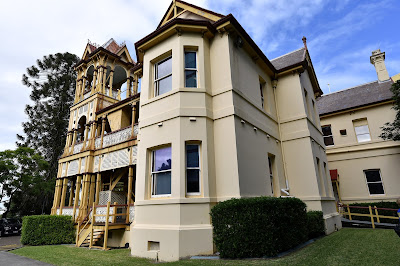
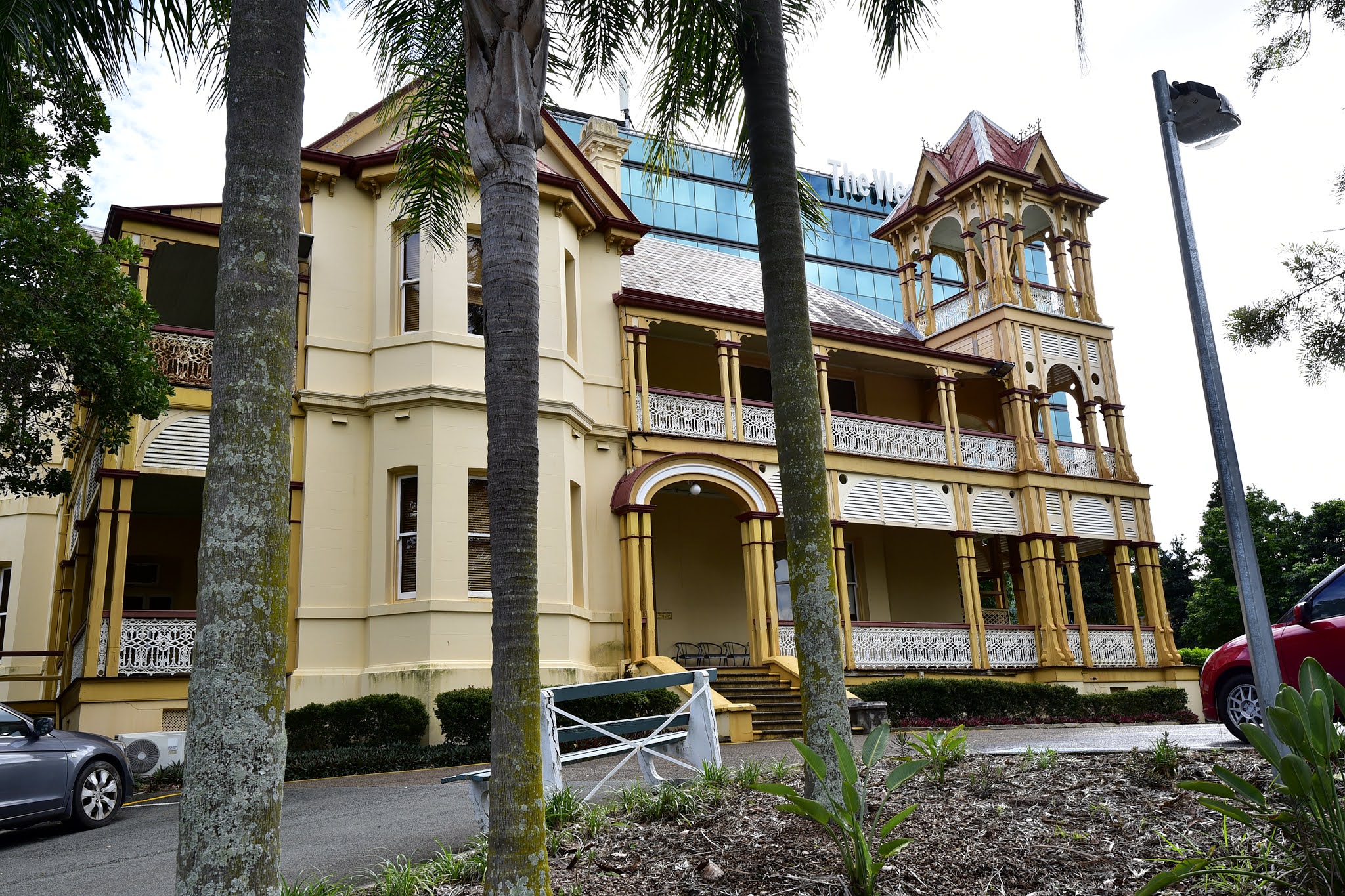
The house at 40 Teneriffe Drive on the left at the top of the stairs that ascend from Paterson street is “Ormond”. Built in 1909 for Dr. E. W. H. Fowles. Dr. Fowles born at Oxley and the son of a school teacher became a well known identity in early 20th century Brisbane and Queensland. A barrister by profession the house is allegedly named after Ormond College at Melbourne University where he studied.

A biography of the life of a Teneriffe resident whose family provided a great service to the people of Queensland is provided in the link following.

https://adb.anu.edu.au/biography/fowles-edwin-wesley-6226

During WW2 the US forces occupied Ormond and Teneriffe House and the local stories abound. One being that a staff car would be ordered to ferry the officers the 50 meres between the two houses.


Telegraph (Brisbane, Qld. : 1872 - 1947), Saturday 29 December 1945, page 4
________________________________________
FOWLES. Relatives & Friends of Mrs. E. W. H. Fowles, of "Ormond," Teneriffe, are invited to attend the Funeral of her beloved Husband, Edwin Wesley Howard Fowles, M.A,, L.L.B., D. Litt., to leave Kingsholme Methodist Church, Teneriffe, on conclusion of Service commencing at 10 o'clock on Monday Morning, for the Mt. Thompson Crematorium. No flowers. JOHN H1SLOP & SONS. Funeral Directors. 


Friday, October 8, 2021

Mullen's Cottages

 The Shafston Estate and Kangaroo Point had numerous features to draw residents. Though separated from the city by the river, ferry services were provided and industrial work was available in the area. Nearby services like hotels, churches and schools added to its residential appeal, and a water supply was added in the early 1870s. The size of the allotments on offer in the Shafston Estate was a further inducement: the subdivisions ranged from 40 perches to four acres, significantly larger than the allotments available in other inner-city areas like Spring Hill or Petrie Terrace. 


In January 1876 labourer John Mullen purchased one rood (40 perches, or a quarter of an acre) of land in the Shafston Estate. The block fronted Cairns Street, with a side frontage to Lambert Street. Mullen, who had arrived in Brisbane with his wife and five children in 1873, took up residence in Cairns Street by 1878. He may have been in residence earlier; in October 1876 his Cairns Street ‘property’ was used as a reference point in sales notices, though whether he was living there at the time is unknown. Mullen likely built the house himself. The transverse gable house was two-storeyed, with a small room upstairs, likely to accommodate his family. Downstairs, the house featured a fireplace and brick chimney to provide heat, while verandas on three sides allowed occupants to take advantage of the river breezes and the dual street frontage. Kitchen quarters were built in a separate extension. The house was similar in style to neighbour John Gibbins’ house, which was built on the opposite side of Lambert Street at around the same time (1876-8), and is also included on the Brisbane City Council heritage overlay. 


In 1882 Mullen moved to Bowen Bridge with his family to operate the Bowen Bridge Hotel, leasing his Kangaroo Point house to tenants. Three years later, however, his application for a renewal of the licence was refused, and he returned to Kangaroo Point. From there, Mullen took up work as a quarryman, licensing the Merton Road quarry in Woolloongabba. Additionally, he took advantage of his large landholding to construct three small rental properties next to his house in 1886. The forty perch site was not large enough to provide each house with a sixteen-perch land holding, the minimum subdivision size required under the Undue Subdivision of Land Prevention Act 1885. Mullen circumvented the legislation by keeping the houses on a single holding.

Mullen’s cottages were constructed at the height of a population and building boom in Brisbane. This boom saw dramatic growth in the demand for housing, especially on the south side of Brisbane. Demand was particularly high in Kangaroo Point, where the population had increased from 1,903 people in 1881 to 3,204 in 1886. In response to the increasing population, landowners like Mullen constructed rental houses on their properties. Mullen’s single storey cottages were smaller than his own house, but proved popular for workers seeking employment in the city or local area. The cottages were particularly well situated for the latter purpose, as Moar’s shipyard opened at the river end of Cairns Street in the 1880s, providing job opportunities for wharf and ship workers.

Mullen resided in his Cairns Street house until his death in 1898, when the property passed to his unmarried daughter Margaret. She retained ownership of the property until 1945, leasing all four cottages. The area remained popular with tenants, particularly following the opening of the Story Bridge and the re-opening of the Cairns Street shipyard in the 1940s. The family’s old house was rented to a series of tenants, mostly working class, widows and wharf workers. The cottages passed through a number of owners in the latter half of the twentieth century and were restored in the 1980s. They were held on a single block of land until 2007. In 2009 the houses were converted to commercial use and in 2016 operate as offices.

Thursday, October 7, 2021

Thornclyffe - Remastered Elegance

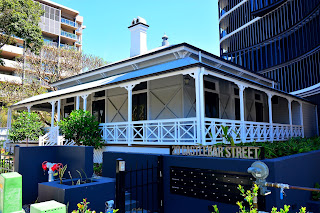
There are advantages to the life of heritage buildings when developers become involved. This is Thornclyffe now remastered as part of a new apartment complex in Kangaroo Point. The striking contrast of 19th and 21st century architecture is a feature of the streetscape.


The following is taken from the Brisbane City Council's Heritage Register.

This house is located on land owned at one stage by Queensland explorer, squatter and writer of Queensland history, Henry Stuart Russell.1 Russell, who purchased the property in 1852, completed the notable Kangaroo Point home of Shafston House, which had been started by the previous owner Robert Creyke.2 This property was part of the land which adjoined the house.3 This land was one of a number of allotments (covering over 44 acres) that were offered for sale by the Honourable Louis Hope.4 Hope, apart from being owner of Shafston House, was M.L.C. from 1862-1882 and was a major figure in establishing the colony’s sugar industry.” 
Thomas Faulkner purchased various parcels of land offered by Hope during 1875 and 1877 and subsequently sold the land to Barbara Murphy, “Widow” in 1881. The land sold by Faulkner to Mrs Murphy was not one complete allotment. Faulkner rather provided the land to Mrs Murphy from the various separate allotments he had purchased from the Hope sale. Thus a new title was drawn up providing Mrs Murphy with just over one acre and one rood, which extended in an offset pattern from the corner of Lambert Street and King Street (now Castlebar) to the Brisbane River.
The house appears to have been constructed in c1884-1886, the Post Office Directories showing the property as “vacant land” in 1883-1884. In October 1886 Barbara Murphy secured a mortgage from Sir Thomas McIlwraith for £800. She subsequently took out further mortgages in June 1887, June 1888, and October 1888 for £300, £300 and £200 respectively. In 1886 Barbara Murphy married Henry William Llewellyn. Llewellyn joined the Queensland Public Service three years later as a “Draftsman & Clerk” in the Colonial Secretary’s Department.
Although the Llewellyns appear to have resided at “Thornclyffe” up until the early 1890s they retained ownership until December 1907. This house was constructed during the height of the housing boom of the 1880s. This boom saw an expansion of residential. It was clearly constructed as a substantial residence in an idyllic locality at Kangaroo Point, designed to take full advantage of its high position along the Brisbane river. The land, at the date of construction, not only provided river frontage but, also bounded Shafston House. Shafston House had recently (1883) undergone extensive renovation.

Of interest to me is the information relating to the building of the house by Barbara Murphy in 1881. My research has found that Barbara Murphy at that time was the widow of Francis Bartley Murphy (grazier) who had died in 1877. Barbara McLean had married France Bartley Murphy in June 1867. 

Brisbane Courier (Qld. : 1864 - 1933), Saturday 9 August 1879, page 6
________________________________________
Legal Notices.
In the Supreme Court of Queensland.
Ecclesiastical Jurisdiction.
In the LANDS and GOODS of FRANCIS BARTLEY MURPHY, late of Maxvale, Maranoa, in the Colony of Queensland, Grazier, Deceased.
NOTICE is hereby given that, after the expiration of fourteen days from the date of the publication hereof, application will be made to the said Honorable Court that LETTERS of ADMINISTRATION of all and singular the legal and personal estate and effects of the above-named Francis Bartley Murphy, deceased, who died intestate, may be granted to BARBARA MURPHY, of Maxvale aforesaid, Widow of the said deceased.
Dated at Brisbane this 8th day of August, A.D. 1879.
CHARLES STUART MEIN, Proctor for the Applicant, Queen-street, Brisbane. 

The marriage of Francis Bartley Murphy and Barbara McLean was notified in the press of the time.

Rockhampton Bulletin and Central Queensland Advertiser (Qld. : 1861 - 1871), Saturday 15 June 1867, page 3

MARRIAGE.

ON the 13th instant, at the English Church, Rockhampton, by special license, by the Rev. Mr. Searle, Francis Bartley Murphy, youngest son of Bartley F. Murphy, Esq., M.D., Dublin, to Barbara, eldest daughter of Jonathan McLean, Esq., Bindango, squatter, Queensland.

Home papers please copy.


Alpha Cottage - Lost in Time

 Kangaroo Point still existed as a shire or town until the amalgamation of the nineteen town councils and shires that made up the greater Brisbane area. The Government of Queensland created the City of Brisbane with a view to uniting the then Brisbane metropolitan area under a single planning and governance structure. The City of Brisbane Act 1924 received assent from the Governor on 30 October 1924. On 1 October 1925, 20 local government areas of various sizes were abolished and merged into the new city. While the Kangaroo Point of today bears very little resemblance to 1925 if you look there are still examples of the early colonial era. 


The following is taken from the Brisbane City Council's Heritage Register.

‘Alpha Cottage’ is located on land that was acquired by Queensland explorer, squatter and writer of Queensland’s history, Henry Stuart Russell. Russell purchased the property in 1852, and completed the notable Kangaroo Point home of Shafston House, which had been started by the previous owner Robert Creyke. This particular allotment (then 1 rood) was purchased by Francis Blanchard in 1875. It was one of a number of allotments (covering over 44 acres) that were offered for sale by the “Honourable” Louis Hope in December 1874.

 Hope, was a MLC from 1862-82 and was “a major figure in establishing the colony’s sugar industry.” Blanchard took possession of the land in late 1875. However, the listing of the cottage did not appear in the Post Office Directories (PODs) until the 1883-84 edition. Neither Blanchard or his wife appear to have ever lived in the cottage. Francis Blanchard is first listed in the PODs in 1889, where his occupation is supplied as Pilot. His address is listed as Cardwell. Blanchard’s name then disappears from the Directory to reappear in 1901 where he is listed as “Magazine Keeper of Pinkenba.” In 1910 the cottage passed onto his widow, Emma Blanchard who is listed as living in Cornwall Street Woolloongabba. The property was transferred to Katherine Nicholson and Florence Burrell in the following year.

Tuesday, October 5, 2021

Herberton Albion

This late nineteenth century timber and tin cottage was constructed circa 1888 for Thomas Madsen, a labourer and van proprieter. It is a fine example of a worker’s cottage built during Albion’s emergence as a prosperous suburban centre. Madsen sold the cottage in 1897 to James Brier who named it ‘Herberton Cottage’. It is one of the few nineteenth century colonial workers residences that survive in Albion.


Placed on the Brisbane City Council Heritage Register in January 2004 it is situated just off Sandgate Road, Albion. Albion in the late 19th century was a hive of industry with Andrew Petrie's quarry and brickworks attracting many workers to the area. 


The following is taken from the Brisbane City Council Heritage Register.

While Albion had initially been a semi-rural area dotted with grand houses, the coming of the railway in 1882 saw the urbanisation of the area, which was largely populated by Scottish migrants. In 1885, rail duplication work began from Albion to Eagle Junction stations to meet the demands of the railway branching off to Doomben which resulted in Albion becoming more attractive for residential development. By the late 1880s and early 1890s Albion was one of a number of prosperous suburban centres that had arisen in response to the expansion of Brisbane from its former small city core. This cottage was built circa 1888 for Thomas Madsen after he purchased the 16 perch (405 m2) allotment in 1885. In 1886, Thomas borrowed £140 from the Permanent Building Investment Society and probably used the capital to finance the building of this worker’s cottage. ‘Herberton Cottage’ was one of the earliest houses built in Lever Street; in 1888 there were only three houses and a Wesleyan Church in what was then known as Thomas Street. Madsen worked as a labourer and then a van proprietor and may have been employed at the brickworks at the end of Lever Street. When Madsen sold the cottage in 1897, the new owner, James Brier, named it ‘Herberton Cottage’. In 1915, Alice Tunney purchased the property. Her husband Robert Tunney was also a labourer and may have worked at Campbell’s Pottery. The Tunney’s, who had been living in Lever Street since 1895, may have also purchased, or even built, the neighbouring cottage, ‘Myrtle,’ as Robert Tunney is shown in the Queensland Post Office Directories as living next to Herberton Cottage in 1912. From aerial photographs and sewerage maps, ‘Myrtle’ and ‘Herberton Cottage’ appear to have been identical in design. ‘Myrtle’ has since been demolished and replaced with another house, however ‘Herberton Cottage’ remains as a fine, intact example of a nineteenth century worker’s residence and is one of only a few remaining in Albion.

The Victorian streetscape of Albion remains as a reminder of a time long gone in Brisbane architecture.


Saturday, July 3, 2021

Eridge - Masterton An Inspector's House


The following is taken from the Brisbane City Council Heritage Register.

"Constructed circa 1881, ‘Eridge’ was the home of Walter Scott, teacher and later school inspector and inspector of orphanages. The Scott family were the first residents of Mowbray Terrace, though others followed from the mid-1880s with the sale of residential allotments in the ‘Mowbray Town Estate’. ‘Eridge’, or ‘Masterton’ as it was sometimes known, remained the property of the Scott family until 1980. The house is a fine example of a late nineteenth century timber cottage, featuring a steeply-pitched corrugated iron gable roof."

The real story of Eridge or Masterton is the story of Walter Scott a Queensland public servant who served his state in a number of roles. The house was in the Scott family for alost 100 years and would have stories to tell. The following is the story of Walter Scott and his family.

Walter born in England in 1838 or 1839 was a Scottish trained teacher when he arrive in Brisbane on the barque "Great Queensland" on the second of September 1873. He already had a family with the second and third of his childfren born in Jedburgh, Scotland. Jedburgh situated just north of the British border with Scotland and within close proximity to the home of Sir Walter Scott. In 1871 our Walter Scott is recorded as living in Jedburgh.

When arriving in Brisbane in 1873 it was not long before a son Walter James Scott was born in November of that year at Herschell Street in Brisbane. It must be remembered that the streets of Tank and Herschell were streets of domestic housing or accomodation. 

The barque "Great Queensland" had been refitted to become a vessel used by the Queensland Colonial Government in transporting immigrants and goods between England and Queensland. In 1873 when it arrived in Brisbane it was carrying approximately 600 people who were a combination of fee paying and assisted immigrants. 

Queenslander (Brisbane, Qld. : 1866 - 1939), Saturday 6 September 1873, page 3

THE IMMIGRANTS.

THE immigrants by the Great Queensland were brought up from the Bay on September 3, by the steamers Kate and Settler. The Kate first reached the Queen's wharf (at 3 o'clock), about which a large crowd had col-lected to welcome the new comers, who were greeted with hearty and prologed cheers, which were as vigorously responded to by the immigrants. About fifteen minutes afterwards the Settler also turned Kangaroo Point with her living burden, and on arriving at the wharf her passengers met with an equally enthusias-tic reception. The arrangements for landing the passengers and their luggage were very complete, little if any confusion occurring. The new arrivals appear to be of a respectable class, and all seemed on landing quite jovial, and, judging from the remarks of several after a stroll through Brisbane, by no means dissatisfied with their first impressions of the colony. A large number appear to have friends or relatives in the city, as out of the 658 souls landing only about 510 sought the Immigration Depot,   

Six deer, from Her Majesty, were landed in splendid condition ; one fawned upon the passage, but the fawn unfortunately died, the mother having little milk. 

On board the "Great Queensland" was a personal gift to the people of the colony of Queensland. The gift was six red deer from Queen Victoria's personal Windsor Forest estate. She had personally provided this gift of the red deer. 

It could be assumed that given Walter's previous teaching experience he would have emigrated into the colony ready to take up a teaching position. This may have already have been arranged as he was an assisted immigrant. On arrival in Queensland he started his employmen with the then Department of Instruction and had a number of head teacher positions including Eagle Farm, West End and Kangaroo Point schools.

In his 2014 thesis The Rise and Demise of the Inspector of Schools in Queensland,
Geoffrey James Swan O.A.M. FACE., B.Ed., M.Ed. Administration, M.Ed.Studies, Ph.D. 
University of Queensland provides the following information.

Walter Scott on his role as an Inspector of Schools

English-born and Scottish trained Walter Scott kept letters and diaries that have been
preserved by his descendants. Scott, like many of his colleagues, left his family to
enjoy a more comfortable life in Brisbane while he lived ‘on the road’ in his district.
In 1885, while in the Mackay district on his first inspectorial trip, Scott wrote to his
wife:
You say you hope I like my new life, but that I say nothing about it. The fact is
that it is too soon to give a dogmatic opinion on the matter. From the
continuance of wet weather, my work has hitherto been carried on under
unfavourable conditions, but I am hoping for improvement in that respect. Still
it’s a lonely life; little else than a coming in contact with a constant succession
of strangers, to whom I can have no more than a passing interest.

In his letter, Scott outlined his program for the next two weeks. It involved
visiting schools in the Mackay hinterland, which involved riding 372 miles. He
considered that the planned trip could take three weeks if creeks were flooded or the
‘horse being knocked up; or self ditto’. Scott also complained in his diary and in
letters to his wife about the carping and criticism from Head Office:
It seems to me somewhat strange that the Under Secretary and the General
Inspector, with all their experience, seem unable to see a foot before them
without a lot of explanation to guide them. And then, on the other hand, they
deprecate what they are pleased to consider useless letter writing. 

In 1897 Walter Scott became Inspector of Orphanages, a role less physically
demanding than that of an Inspector Schools. There was a Sub-Department of
Orphanages within the Department of Public Instruction.

The life of a school inspector would have been a lonely and arduous one. Travel to the regional coastal centres was by boat and then by horseback to teh remote schools of the district. A far cry from the rural village and town life of Victorian England and Scotland. 

Mrs Violet Scott was always in need of a servant at Eridge on Mowbray Terrace. The newspaper advertisements for a general servant, house servant and maid are quite extensive in the 1880 and 1890 period. This time period coincides with the time Violet Scott would have been required to manage the household and daily affairs. She would have spent  considerable time at home without her husband as he travelled the colony in his role as an Inspector. 

Walter Scott Inspector of Orphanages

When the first Inspector of Orphanges Charles Horrocks died in 1896, Walter Scott was a man experienced in the role of a senior public servant and one with great knowledge of Queensland's geography and people. He had travelled extensively across the colony for many years and had a great knowledge of children and education in Queensland's colonial context. He was appointed to the role as Inspector of Orphanages following the death of Horrocks in 1896. He was the only Inspector and was responsible for all of the children under the care of the colony who were governed by the act passed in 1879.

What was the role of the Inspector and Orphanages in our colonial history?

The following is taken from the web site https://www.findandconnect.gov.au/

The Orphanages Act 1879 (Act no. 16/1879) was an act to govern orphanages which were charged with the care, teaching and training of children whose circumstances included death of one or both parents, desertion by parents, or neglect. It was assented to on 2 October 1879 and its full title was "An Act to make better provision for the Establishment and Management of Asylums for Orphans and Deserted and Neglected Children". The Act also provided for the boarding-out, hiring-out and apprenticing of orphanage children. This act was repealed by the State Children Act 1911 (Act no. 2 Geo.V.No.11) on the 30th of November 1911.

The Orphanages Act 1879 permitted destitute or deserted children under the age of 12 years to be sent to an orphanage and to remain there until they reached 12 years of age, unless boarded out with a 'trustworthy and respectable person' or hired out or apprenticed. A child could be hired out or become an apprentice at 10 years of age. At this time, the state subsidised orphanages in Brisbane, Rockhampton and Townsville, and an inspector of orphanages was appointed. Parents or relatives of children living in these institutions were expected to contribute to their support.

The position of Inspector of Orphanages was created under the Orphanages Act 1879. Charles Horrocks, born in Weimar, Germany in 1844, was Inspector of Orphanages from 6 November 1884 until his death on 20 October 1896.

As Inspector, Horrocks sought and obtained government approval for the age limit for employment of orphans and children in care to be raised to twelve years. He also helped to develop the boarding out system of child protection (fostering and employment) in Queensland.

He was a delegate at the 1891 Intercolonial Charities Conference in Melbourne, representing the Queensland Government. He presented a report to government in 1891 recommending that the child protective and corrective structures in Queensland should be united in one department under a single director. The State Children Act1911 implemented some of Horrocks's proposed reforms.

------------------

The Diamantina Orphanage was established at Roma Street, Brisbane in 1865. The Queensland government assumed control following the passing of the Orphanages Act 1879. The Orphanage moved location twice, to South Brisbane in 1883 and to the Brighton Hotel, Sandgate in 1893. In 1910, it underwent another name change and moved again to Wooloowin, at which time it became the Diamantina Receiving Depot and Infants' Home.

Mary Ann Douglas, wife of Queensland Legislative Assembly member John Douglas, founded Diamantina Orphanage in 1865. The Orphanage was named after Lady Diamantina Bowen, wife of the Queensland Governor George Bowen. She stimulated the founding of a number of charitable organisations in Queensland, including the Lady Bowen Lying-in Hospital and the Diamantina Orphanage.

The Queensland State Archives provides the following history of the Diamantina Orphanage:

ESTABLISHMENT AND FUNCTIONS:
From 1865 children were admitted to the Diamantina Orphan School, and a Visiting Inspector and Managing Committee were appointed on 1 Feb 1866. No precise date for the opening of the orphanage has been located in any primary source.

The orphanage was charged with the care and training of children whose circumstances included death of one or both parents, abandonment by parents, or qualification as a "neglected child" under Sec. 6 of the Industrial and Reformatory School Act 1865. The Orphanages Act 1879 provided for the boarding-out, hiring-out, and apprenticing of State children, and the systematic visiting of them by members of the Ladies' Committees.

ADMINISTRATIVE STRUCTURE:
From 1866 the Matron, teaching and other staff of the Diamantina Orphanage were employed by, and were responsible to the Managing Committee of six ladies and two visiting inspectors. An Inspector of Orphanages was appointed on 1 Apr 1875, and in 1876 responsibility for orphanages was transferred from the Colonial Secretary's Office to the Public Instruction Department. This was given legislative status under The Orphanages Act of 1879, and the Public Instruction Department, Orphanages Branch was established. Orphanages remained subject to Inspection while members of the Ladies' Committees reported on the well-being of children who were boarded-out or hired-out.

HISTORICAL NOTE:
The Diamantina Orphanage closed as an orphanage in 1893 (circa year), but the re-named Diamantina Receiving Depot continued its role of reception, care and boarding-out of children to foster homes. In Jan 1910, the Depot re-located to Wooloowin and occupied the same building as the Infants Home. On 17 Dec 1964 the Diamantina Receiving Home was renamed "Warilda" which became the Receiving and Assessment Centre for children in southern Queensland. Increasingly, by the end of the 1980s, Warilda became a centre for placement breakdown children, and on 1 Jan 1989 ceased operating as a departmental institution.

A former resident of Diamantina Orphanage was Andrew Dawson, who served as Premier of Queensland for one week (1 to 7 December) in 1899. Dawson was placed in the Orphanage at 6 years of age, following the death of his parents. He remained in the orphanage until he was nine. Andrew was then discharged into the care of an uncle who took him to live in Gympie.

Location
1865 - 1883
Location - The Diamantina Orphanage was situated at Roma Street, Brisbane. Location: Brisbane
1883 - March 1893
Location - The Diamantina Orphanage was situated at Ipswich Road, South Brisbane. Location: South Brisbane
March 1893 - January 1910
Location - The Diamantina Orphanage was situated at Brighton Terrace, Sandgate. Location: Sandgate

Walter Scott and Retirement

Walter Scott retired in 1908 and continued an active life with a newspaper reference to his role as a Diocesan Synodsman at the age of 82. Walter died on October 18, 1932 at the age of 93. One funeral notice was from the East Brisbane Bowls Club advising of the funeral of their esteemed life member and his burial at the Bulimba Cemetry. His funeral service took place on Friday March 11, in the nearby St. Paul's Church of England, Vulture Street. Just over eighteen months later the funeral of his daughter Alice Mary Scott of Eridge, Mowbray Terrace was held in the same church.

Obituary of Walter Scott - A Fitting Tribute

Brisbane Courier (Qld. : 1864 - 1933), Monday 14 March 1932, page 12

OBITUARY

Mr W. Scott.

The late Mr. Walter Scott, who died last Wednesday at his residence, Mowbray-terrace, East Brisbane, at the age of 93 years, was born at Malton, Essex, England, and was educated at St. Ninian's College, Perth, Scotland. He entered the Episcopal Training College. In 1859 he began-a three-year course in the parish school at Stanwix, Carlisle, England. In 1862 he went to St. John's Episcopal School at 
Jedburgh, Scotland, and remained there for 11 years, leaving to come to Australia with his wife and four children, settling in Brisbane. The following year he was appointed head teacher of the Eagle Farm State School, and with the opening of the West End State School in 1875 he accepted a similar position there, which he held until 1879, when he went to the Kangaroo Point Boys' School.

In 1885 Mr. Scott was appointed a district inspector of schools, and held that position until 1897, when he was appointed inspector of orphanages, and retained that position until his retirement in 1908 at the age of 70 years. Not with standing his age he did not remain idle, and shortly after his retirement he was appointed secretary to tho Medical Board, a position he occupied for 17 years, when he finally retired. Mr. Scott was a prominent churchman, a member of the Diocesan Synod, and a keen supporter of St. Paul's Church of England, East Brisbane. He was one of the oldest bowlers in Queensland, being a member of the first bowling club at Booroodabin, and at the time of his death was a life member of the East Brisbane Bowling Club, with which he had been associated for many years. Mr. Scott's wife predeceased him by seven years, but he is survived by three sons, Messrs. W. J. Scott (Brisbane), C. E. Scott (Herberton), and A. H. Scott (Rockhampton), and six daughters, Mesdames W. A. Preston, J. C. Preston (Sydney), E. M. Henzell, and Misses Alice, Maude, and Beatrice Scott.

The funeral took place to the Bulimba Cemetery on Saturday, after a service at St. Paul's Church, conducted by Rev. K. A. Watts. During the service the organ, which Mr. Scott at one time played as church organist, was played by Mr. E R. B. Jordan, and the solo, "O! Rest in the Lord," was rendered by Miss Jean Rigby. A large number of relatives, friends, and representatives of organisations with which Mr. Scott and his family were connected attended the service at the graveside.

The Son Born in Herscell Street - Walter James Scott

Courier-Mail (Brisbane, Qld. : 1933 - 1954), Saturday 5 August 1939, page 7

Retires After 50 Years In Titles Office

There had practically been no change in the work at the Titles Office since he entered the service 50 years ago, said Mr. Walter James Scott, examiner, yesterday, after he had been presented by the Registrar of Titles (Mr. J. R. McPhie), on behalf of the staff, with an ink stand, suitably inscribed, to commemorate the occasion. Mr. Scott also received a parchment scroll, signed by the members of the staff, congratulating him on his record service. Born in Herschell Street, Brisbane, on November 18, 1873, Mr. Scott entered the Titles Office in 1889, after leaving the Brisbane Grammar School. He did most of his service in the Brisbane office, but spent several years in the Townsville office.

Friday, June 25, 2021

A Norman Door - Mr. Christmas and Woolworths

In 1937 when Cecil Robert (C.R.) Christmas commissioned the well known Brisbane architect Horace Driver to design his substantial new home would he have thought that nearly 85 years later it would still be standing providing the same street character when first built. The large timber wooden door with wrought iron bracket hinges are still a feature today. The black and white photograph from the Better Homes feature in 1937 provides a good comparison of then and now. C. R. Christmas was the Queensland general manager for Woolworths stores. In 1937 they were establishing themselves in Brisbane and regional centres. In 1953 when C. R. Christmas retired there were 30 Woolworth stores in Queensland.


A Little Bit of England and the Norman Look

Telegraph (Brisbane, Qld. : 1872 - 1947), Tuesday 13 July 1937, page 17


BETTER HOMES

A LITTLE BIT OF ENGLAND

The striking home of Mr. and Mrs. C. R. Christmas in Adelaide Street, Clayfield, is one that has attracted a gqod deal of attention since its completion recently. Apart from its commanding position set well back on excellent grounds, the mellow atmosphere of the old English country house brings pleasant pictures of rural England to the mind of the passer by.

There are many interesting features in the external design, and one that first impresses the visitor is the rugged entrance porch of early Norman character which is earned out in multi-coloured porphry with concentric receding arches.

An electric push-button bell seems out of place here, but in these days of 20th century bustle and noise the old world hand bell or heavy wrought knocker would be just out of the question from the practical point of view. Sheltered within the mellow stonework is a stout wooden door with typical wrought-iron bracket hinges lighted at night from a wall lantem. Another feature of interest is the chimney of arrised brickwork, which has its base in stucco work rising from the main wall. Terminating in a corbelled pot effect, it is surmounted by a plain top, which contrasts with the colourful roofing plan. Dormer windows and half-timber breaking through the general design here and there give this fine home a delightful effect. The architect was Mr. Horace Driver.

C. R. Christmas Retires

Brisbane Telegraph (Qld. : 1948 - 1954), Tuesday 7 July 1953, page 2


CHAIN STORES HEAD RETIRES

A man who conducted 30 stores throughout Queensland with the motto "The customer is the most important person" retired today.

He is Mr. Cecil Robert Christmas, for 23 years Queensland manager of Woolworths Ltd. Today he recalled the growth he had seen since he came here in 1930 when Brisbane was a small town, and Woolworths had only three branches trading in the State at Queen Street, the Valley, and Ipswich. The firm, which had no connection with the American Woolworths, was founded by a brother of Mr. Christmas, the late Mr. H. P. Christmas. Before joining the firm in 1930 Mr. C. R. Christmas had experience here in 1913 as representative of a southern wholesale firm, and again in 1918 when he conducted his own business as repre-sentative of various southern overseas firms. An Anzac, with service in Gallipoli, Egypt and France, and winner of a Military Medal, Mr. Christmas in 1922 was appointed manager of a Sydney wholesale ware-house. Mr. Christmas will now make an overseas trip, partly for pleasure and partly to further the business interests of his son. This afternoon the staff of the 30 Woolworth stores throughout Queensland made a presentation to Mr. Christmas. Tomorrow night, the Australian manager (Mr. T. Kelly), branch managers and executives of the company will make a presentation at a dinner at Lennons. Last week directors of the company made a presentation to Mr. Christmas at a dinner at Usher's Hotel, Sydney.

The Christmas Name and Woolworths

The Woolworths Australia Group was first started by Cecil Robert's older brother H. R. Christmas in Sydney. The following internet links provide good reading on what we know today as the Woolworths Group. It all started in Sydney's Imperial Arcade on December 5 1924 when Harold Percival (Percy or H. R.) Christmas opened his Woolworths Stupendous Bargain Basement store.

https://kiamalocalhistory.wordpress.com/2009/09/28/christmas-came-from-kiama/

https://adb.anu.edu.au/biography/christmas-harold-percival-percy-5591

The Woolworths name through the Christmas family business has become part of Australia's retail history. The company has moved with the growth of Brisbane and suburban shopping trends. Initially a city store where shoppers came into shop they moved with the trend to suburban shopping as Brisbane's growth spread out into the suburban areas.  

Suburban Shopping Growth

Courier-Mail (Brisbane, Qld. : 1933 - 1954), Friday 30 January 1953, page 5


NEW SHOPS TO MEET GROWING SUBURB TRADE

HUNDREDS of Brisbane housewives are are now shopping in the suburbs.

And chain stores are moving into suburban shopping centres to cater for the new trade. BCC Stores will open their 18th branch in city and near-country areas at Ashgrove today. The new store is on the Ashgrove tramline and a the terminus for buses serving the fast-expandinig Oakleigh area. Retailers spokesmen said yesterday that two other big Brisbane chain-store organisations were believed to be looking for vacant sites in the area. Several new shops and a service station have been built along Waterworks Road, Ashgrove, in the last three years. The Commonwealth Bank will soon begin construction of a new branch office there BCC's managing director (Mr. C. A. Fraser) said yesterday that retailers were doing a public service by opening shops in developing suburbs. Housewives can do most of their shopping near home he said. Out-of-town stores ease car and pedestrian congestion in the main city area.

14 More stores

Mr. C. R. Christmas, Woolworths State manager, said his firm planned at least 14 more stores in Brisbane and country centres. They included branches at Stones Corner, Nundah, Redcliffe, Nambour, Charters Towers, Toowoomba, and Atherton. He said the high cost of tram and bus fares was making it difficult for people to come into the heart of the citv to shop. Brisbane's suburban shopping centres were developing like those in Sydney and Melbourne. They would ease city parking problems.

Moorlands - The Last Mayne Standing


The Mayne family are to many part of Brisbane’s folklore. A family who did not survive in time but have become the talking point for those who love a good story. A murder mystery, ghosts, ghost tours, the plot for theatre plays are all part of the Mayne story or is it the real story.

Rosamond Siemon wrote a novel “The Mayne Inheritance” in 1997 and was ironically published by the University of Queensland Press. This post is not about the book the Mayne Inheritance or whether Patrick Mayne was a murderer and all of the other stories that have evolved out of Simeon’s 1997 book. This post is about who has really benefited from the Mayne inheritance. The content of each will of the last two surviving children in Dr. James O’Neil Mayne and his younger sister Mary Emelia Mayne have created a legacy that has been benefitted by many and is really the untold story of the Mayne family.

If you have no knowledge of the Mayne family or the book the "Mayne Inheritance" then the following web links may assist. It may be necessary to read the Simeon's book to get a real sense of the Mayne family story. 

https://en.wikipedia.org/wiki/The_Mayne_Inheritance

https://adb.anu.edu.au/biography/mayne-patrick-13088


This is Moorlands the grand 19th century home of the Mayne family. Designed by Richard Gailey at the request of Mary Mayne it was another of those grand villas on large estates on the edge of the Brisbane town. A house with its own story to tell. Mary Mayne and her five surviving children all lived there at some point in time. Is this the last visual link to the Mayne family or have they left a legacy that may never fade? The last Mayne standing is quite a catchy title for this post but even though there are no more Mayne descendents there is now a lot more that is visible which makes up the Mayne family's legacy.

After Patrick Mayne died his wife Mary a very astute business person traded the family out of Patrick's debt and wisely created the portfolio that would establish the family's real wealth. The following written by Bernadette Turner provides an insight into Mary Mayne.

Mary Mayne: Matriarch and Colonial Businesswoman

Published online by Cambridge University Press:  26 February 2016

Bernadette Turner

Extract

Mary Mayne was the mother of Mary Emelia and James Mayne, two of the most significant benefactors to The University of Queensland, and the impulse for their philanthropy can partly be traced directly to her. She was an extremely successful businesswoman in colonial Brisbane, yet her business achievements have been overlooked by assumptions that the family's wealth came only from the foundations laid by her husband, Patrick — even though it was her fortune, as well as his, which funded her children's final bequests to the university. By the time of Patrick's death in August 1865, Mary was experienced in business, which was unusual for married women during this era. Her experience and skills enabled her to take over the administration of his estate and, despite his debts, to preserve most of his property holdings. At the same time, she amassed her own fortune. Although she faced a number of hurdles, her success proves that widows with skills and assets were able to operate as effectively as men in the commercial world, and undermines simplistic assumptions about the impact of gender discriminatory barriers in colonial society.

An Alternative View of The Mayne Inheritance

Brisbane barrister Stephen Sheaffe AM wrote an article for the Bar Association of Queensland's on line journal Hearsay challenging Simeon's version of the Mayne family and the manner in which the family inheritance was created. 

https://www.hearsay.org.au/the-true-facts-behind-the-mayne-inheritance/

I have provided some exerts from the article but a complete read of Sheaffe's article is worth while for those who want to hear another point of view.

The Mayne Inheritance, written by Rosamond Siemon and first published in 1997, asserts that the magnificent University of Queensland standing on the bend in the river at St Lucia was built on land purchased with money tainted by murder and theft. The author pleads that if it was not for a murder and robbery the university may not have been built at this iconic location. It is a well written, extraordinary and irresistible tale that has been well acclaimed but has stirred the emotions of professional and amateur historians.

The university, originally located adjacent to the Botanical Gardens in Brisbane was considering options to relocate to another site. In 1927, siblings James and Amelia Mayne stepped forward and offered to fund the acquisition of the beautiful rich land at St Lucia for the benefit of the university. The offer was accepted, the land was acquired and it must have been a proud moment when in 1937 they witnessed the ceremony for the laying of the foundation stone for the new Forgan Smith building. On their deaths, James and Amelia bequeathed their large estate to the university, they being very significant university benefactors and possibly the largest in the history of the state. The annual cash distribution to the Medical School from the Mayne Trust totals many millions of dollars.

Issues

Siemon maintains that in 1848 Robert Cox arrived in Brisbane with a large sum of money in his bag. Notwithstanding that William Fyfe was convicted of Cox’s murder, Siemon alleges that Mayne murdered him, stole his money and used the funds to purchase a butcher shop in Queen Street. This acquisition was the foundation stone for a massive property empire that was built over the following decades. Finally, she asserts that in 1865 Mayne confessed to the murder. Ultimately, it was this property empire that funded the purchase of the university land.

In this paper, I have only considered original sources to determine whether there is any evidentiary basis to support Siemon’s contentions. The evidence I have examined include: The statements tendered at the inquest [3] , the newspaper recordings of the evidence tendered at the murder trial in Sydney and the oral comments made by Siemon in our discussions. I have not relied on the opinions and comments of any academics. I have examined the evidence, applied a strict forensic legal discipline and asked whether there is any evidence to support the contentions raised.

There are four issues:

  1. Is there any evidence to prove that Cox possessed a large sum of money in 1848?
  1. Is there any evidence to prove Mayne murdered Cox in 1848?
  1. Is there any evidence to prove that Mayne stole Cox’s money and used these funds to acquire a butcher shop in 1849?
  1. Is there any evidence to prove that Mayne made a deathbed confession to murdering Cox?

To consider these questions and to form my own opinions, I had the privilege of visiting Siemon at her home on three separate occasions to discuss the evidence that she relied on. During our friendly and amicable discussions, Siemon maintained her view that Mayne murdered Cox although she did make one major concession that will be referred to later herein.

This paper considers the issues raised in the debate held at the university on 12 May 2013 between both Siemon and I. The topic for debate was: Did Patrick Mayne murder Robert Cox? We also participated in a short debate on ABC radio a few days before the university debate, when jointly interviewed by Steve Austin.

Is there evidence to prove that Cox possessed large sums of money?

Richard Smith came with Cox from the Tweed and gave evidence that Cox had a £4 order with him and he did not see any other money in his possession [7] . This £4 order was handed to Sutton and Smith observed Sutton give Cox £2 and promise the rest when the order was ascertained to be good. In his statement, Smith also made the vague statement that “Cox had 16 or 17 thousand feet of cedar which I think he sold before he left the Tweed. My reason for supposing he sold (it) is that I know he had no intention of returning to the Tweed and that he brought the timber to the place where the vessel was building”. Based on this statement, Smith said he believed that Cox had other money in his possession as he had sold the timber, but he did not see any.

Joseph Liddiard, a blacksmith gave the best evidence on the issue of money. Liddiard became acquainted with Cox on the Friday when they discussed work and money. Liddiard offered Cox work in his blacksmith shop and the reply came that; “he had about 25/- to spend, and that when that was gone he would come to work”. Cox also told Liddiard that he had deposited money with Sutton of which only 25/- remained. Thomas Gnosill confirmed the existence of the £4 money order and that Cox received £2 from Sutton, though he said that he did not know if Cox had any other money in his possession. Cox and Liddiard again met on Saturday when walking between Campbell’s Public House and the Bush Inn. Cox now stated that all his money was gone except six pence and what he had earlier consumed at the Bush Inn was not paid for.

After the murder, the police collected and examined all the papers belonging to Cox that had been left at Nosely’s house and these documents were tendered at the inquest. These documents did not provide any evidence of a money order, of a contract for the sale of timber, an invoice or receipt. There was simply no documentary evidence to prove that Cox possessed any money.

The submission made by Mr Holroyd, the barrister for Fyfe at the Sydney trial, and recorded in the newspaper [8] , also adds weight to the inference that Cox did not have money. Holroyd submitted that money was not a motive for the murder as it was proved that all of Cox’s money had been expended.

The relationship between Cox and Fyfe also had a bearing on the issue of money. They were both former convicts from Moreton Bay and knew each other from that time. Cox came from the Tweed a few days earlier and Fyfe commenced work at the hotel as a cook a few days before that. After they met up, they were very close for a short time but eventually the relationship detoriated. Thomas Gnossill observed Cox and Fyfe at breakfast together on Friday morning and to him they appeared like brothers, but by Saturday they were arguing and the relationship had deteriorated .

John Connell gave evidence that on Saturday afternoon between 3 and 5 pm, he observed Cox lying in Fyfe’s bed. They had been drinking and Fyfe was three parts drunk and Cox half drunk. Connell overheard Cox complain that Fyfe had some of his money and in reply, Fyfe shook his hand and said that before he left town he “would knock that man’s head off - that he would have satisfaction of him or kick him in the ribs or something like that”.

After dinner on the Saturday evening, Charlotte also observed Cox and Fyfe in Fyfe’s bed together. She overheard them arguing and heard Cox accuse Fyfe of robbing him. Charlotte asked her father if he thought Cox had any money and the reply came that he thought not.

Connell said he overheard Cox accuse Fyfe of robbing him. Fyfe informed Sutton of the allegations and Sutton responded by telling him not to pay any attention to it and said: “I do not think he had sixpence about him”. Connell also swore that he thought Cox was in danger and he himself was afraid to sleep in the kitchen.

Finally, the reader should be reminded that in 1848, cash was not available like today and there were no banks in Brisbane or elsewhere. If a significant transaction occurred it was usually by money order or calabashes and it would be almost impossible for a timber purchase to be paid in cash.

Siemon appears to have relied on Smith’s vague statement that Cox had sold timber and he may have possessed money. Smith does not say how much was paid for the timber if at all, how it was paid and how he came to have received this information. It seems that this unsubstantiated comment is contrary to every other piece of evidence. Also, it is probable that Cox was an employee and was paid £4 for his services to help extract timber from the Tweed, and Cox was not the owner of the timber. To cut and transport a large volume of cedar I think a crew of axemen, a team of bullocks or horses and organisational skill would be required. It is fanciful to suggest that Cox received a large sum of money in cash for the sale of timber. Furthermore, if he did have cash in his back pocket, why would he be staying at the rough Bush Inn and having to draw down on his money order with Sutton. The evidence is overwhelming that Cox had a £4 money order and this money had been expended and only sixpence remained. The submission by Holroyd that money was not a motive for the murder as all of Cox’s money had been expended is overwhelmingly accurate.

The assertion that Cox possessed a large quantity of cash is wrong and against the evidence

Is there evidence to prove that Mayne murdered Cox?

There is no direct or even circumstantial evidence that Mayne murdered Cox. There are no witnesses to the murder and there is no evidence that Mayne was even present at the time of the murder. Mayne was at the Bush Inn on Saturday evening and early on Sunday morning. He was present at about 9 pm for about 5 minutes and returned with William Lynch, George Platt and Connell at about 12.40 am and stayed until later and during this time they were inside the Bush Inn drinking ginger beer and wine at the bar. The evidence was that they left at about 3am, though Charlotte, being in bed at the time, heard them arrive and leave and gave evidence of slightly different times. Platt and Lynch returned with Mayne to his residence and talked until 4 am.

There is no evidence that Mayne was drunk, and there is absolutely no direct or circumstantial evidence to prove that he murdered Cox. He did not return in the morning and there is no evidence that he stole money. The police took a statement from Mayne, they did not suspect him of being the murderer and no mention was made in the police statements that he was arrested. He was not mentioned as being a suspect in the newspapers.

In my view the claim made by Siemon, that Mayne murdered Cox can be rejected categorically as there is not a scintilla of evidence.

Is there evidence to prove that Mayne used stolen money to purchase the butcher shop?

Not one witness or document is available to support the thesis that theft was the source of the acquisition money. Siemon says that Mayne must have used stolen money, how else could he have funded the purchase. She maintains that he could not move from a penniless Irishman to a substantial property holder in a few short years by legal means only. This allegation has a taint of race or religious prejudice but during those early years, when land was cheap, many people became wealthy property owners.

Siemon’s allegations are extraordinary considering nothing is known about the transaction to acquire the butcher business. Did Mayne acquire the business with or without the real estate, what price was paid, did the seller owe money to a money lender or a third party, was the seller struggling and prepared to accept any price. The money-lenders may have been keen to call in the loan and Mayne agreed to take over the seller’s loan obligation and in these circumstances he would not have needed cash. Mayne may have acquired the business at a very modest price as it was run-down and rented the buildings for a short period until he could afford to purchase the real estate. There are many options available to a purchaser without resort to a baseless claim of theft.

Siemon conceded that Mayne had an extraordinary ability as a businessman. It is highly probable that these skills, together with the skills of his wife, were present for years before they were married. They must have been endowed with skills of thrift and carefulness with money. They were both employed for many years in Brisbane, he a slaughter-man and she a house-keeper and they lived at Moggill for a time, away from the temptation of shops and hotels. It is possible they saved sufficient money for a deposit or even the entire purchase price for a run-down butcher shop at a small-town price. If they did not have sufficient funds for the purchase, a vendor’s mortgage or borrowings may have provided the balance of the funds.

To borrow the large sums of money required to fund his massive property empire, Mayne must have had a sound credit reputation. This reputation could only have been gained by borrowing money and making the required repayments when it was due and owing. This reputation may have begun when he borrowed money to acquire his first business and land, namely the butcher shop.

Timing in the property market is also very important . Mayne acquired his first property in 1849 when land was cheap, at the very time the population of Brisbane began to increase with the arrival of the Lang immigrants. Mayne was the beneficiary of this boom and he did very well as a property tycoon. The alleged stolen funds of £250-£300 would not have made a major difference to the massive increase in wealth that he achieved over the years. His empire was built on borrowed money, on land price increases and not by the theft of a relatively small, unknown and unspecified sum of money.

The allegation that Mayne purchased the business from stolen money is without any factual foundation.

Is there evidence of a confession?

A confession of murder is highly probative and is the best and strongest evidence of guilt. To be a valid confession it must be made with a voluntary mind and must not be made after an inducement was given. Furthermore, a confession is inadmissible if the person making it was of unsound mind at the time.

Siemon clearly appreciated the power of a confession as she repeatedly asserted throughout the book that Mayne made a deathbed confession to murder. The reader is left in no doubt that a confession was made. On page one the author confidently asserts that the murderer confessed in August 1865, on page two she again asserts a deathbed confession and on page 14 the author said that Charlotte’s evidence makes feasible Patrick Mayne’s deathbed confession to the murder of Cox. [9] She wrote that the confession was overheard and by the time of his death it was public knowledge. The confession, she wrote, created a surging buzz of excitement and anticipation [10] .

An examination of this and any alleged confession requires consideration of critical issues, such as who heard the confession, who did he confess to, was the confession in writing or reduced to writing, what words were said, was he of sound mind and what were the circumstances surrounding the alleged confession.

The Mayne Inheritance published in 1997, 132 years after the death is silent on these vital issues. To allege a confession, Siemon should have viewed a document that recorded the exact words used. Unfortunately, she has not done so, though she does attempt to set out the circumstances surrounding the confession. She writes that a codicil appointing Mary as a trustee and executor was drafted by solicitors Raff and Darragh and about ten days before the death, the codicil was executed by Mayne in the presence of Queen Street businessman Robert Cribb and another.

She noted that several people may have visited Mayne during his dying days, people such as Dr Hugh Bell, Father Dunne, the nurse, his maid, his solicitor, members of the family and friends. She does not say they did visit but infers, probably accurately that they did. Also Siemon does not say that Mayne confessed to any of these visitors, but wrote that they could have heard a confession if one was made and they were present. She wrote:

Any one of those could have overheard a rambling or delirious Patrick and subsequently disclose his death-bed confession to murder, which became public property before he died.

Anyone who had ever been harangued by the hellfire preachers about the plight of unrepentant sinner brought to divine justice and the horrific eternal hell of the damned might have shared Patrick’s terrible fear. He had a few despairing weeks to ponder on his future damnation: weeks when he was suspended agonisingly between the successful man he had built himself up to be and the murderer about to face his god. Now, shrunk in illness, with nothing left, not even his size to intimidate his terror, he desperately wanted salvation.

The story was out. Patrick Mayne had committed a murder and the wrong man was hanged for it. The town knew of it several days before he died on 17 August.

Mayne’s confession to the murder in 1848 of Robert Cox created a surging buzz of excitement and anticipation. The public perceived that Patrick was a murderer…

The statement that Mayne must have confessed as he was a dying unrepentant sinner and could not resist the haranguing of a hellfire preacher is not evidence of a confession but is simply emotional and exaggerated story telling. The suggestion that the story about the confession was out in the public arena and that it created a buzz of excitement is baseless. If this occurred, it would have been recorded in private diaries, letters, newspapers and history books. No such contemporaneously written document is known to exist and no evidence is available to prove it was made public. Furthermore, there is simply no evidence that Mayne was then delirious.

If Father Dunne had taken a deathbed confession, and it will never be known if he did, he would never have divulged it to the public or anyone else. If he did, it would constitute a serious breach of the sanctity of a confession, one of the most basic tenets held by the Catholic Church.

This evidence of a confession was raised by me with Siemon at the first of my three visits to her home. Initially, she explained that it was recorded in Father Dunne’s dairy. Siemon explained that about two years before the book was published, she visited the Catholic Archives adjacent to St Stephens Cathedral. She was directed by archivist, Father Martin to a desk where documents were presented to her for viewing. A lady librarian left a copy of Father Dunne’s letter book, about 10 inches by 12 inches in size on an adjacent desk. She said the book contained carbon copies of Father Dunne’s hand-written notes, interviews and letters written during colonial times. An impression, she said, was given that she was not permitted to look at this book but she did. It was this book she said, that recorded the details of the confession.

On closer examination by me, she admitted she could not read the words in the book, as it was almost upside down when she attempted to read it. Despite this, she reiterated that the letters must have confirmed that Mayne admitted killing someone. I rejoined, asking, whether she observed Cox’s name being mentioned, and she replied no. I asked, could Mayne have confessed to killing Schilling and not Cox, and she responded by saying, possibly.

In response to these comments, I also visited the archives to confirm the story and was given access to father Dunne’s diaries. Not only was nothing able to be gleaned from the dairies on the issue, Father Dunne’s handwriting was indecipherable.

After this enquiry at the archives, I again spoke to Siemon about the evidence to support a confession and she conceded that evidence does not exist. In March 2013, Siemon and I were interviewed by Steve Austin on radio about the Mayne Inheritance and again she conceded publically that there was no evidence of a confession.

These concessions mean that her allegations in the book that Mayne confessed are false. The suggestion that Mayne confessed to murdering Mayne can now, at last be buried once and for all. There is no evidence of a confession. In any event, if her assertion that Mayne was of unsound mind is correct his confession has absolutely no probative value.

In summary

Despite this book achieving legendary status, it cannot be used as an accurate portrayal of the history of the Mayne family. This book may have achieved this status because of the deep ingrained tall poppy syndrome. Another reason is its exaggerated and well written prose - it is a very interesting, captivating and easy to read tale. The refusal of the horses to pull the hearse at his funeral being evidence of guilt, the allegation that he was ostracized by the community (the evidence is overwhelming to the contrary), his mental health, the alleged agreement not to have children, other murder allegations and many other issues all make a great story.

In my view the book should be classified, not as a history book but a novel of murder and intrigue set in colonial Brisbane.

Who was James O'Neil Mayne?

Telegraph (Brisbane, Qld. : 1872 - 1947), Tuesday 19 October 1926, page 5

________________________________________

DR. MAYNE'S CAREER.

Dr. James O'Neil 'Mayne, who has lived in retirement for many years, Joined the permanent staff of the Brisbane General Hospital as a resident medical officer in November, 1891, and continued in that capacity until October, 1898, when he succeeded Dr. Jackson as medical superintendent. He filled, the position just over six years, during which, according to the hospital "Monthly Chronicle." of December 24, 1904, "he showed generous self-sacrificing devotion to the hospital and its objects — giving years of his life to patient, earnest endeavour to relieve human suffering ; to make men and women happier, that he might leave the world better than he found it. He was ever mindful of others, and forgetful of self,” adds the official tribute. "Those who lived with him, and knew his daily life and the greatness of his kindly heart, pray that the God whom he worshipped in every act of his life may speedily restore him to health and happiness."

These comments were made on the occasion of his resignation, following treatment in the Sydney Hospital, for a poisoned hand, which caused him very great suffering for some time it being feared that the result would be permanent disablement. On December, 1904, at a special meeting convened for urgent business the committee received a letter from Dr. Mayne, tendering his resignation of the office of medical superintendent, and asking that the committee would permit his locum tenens to Continue to act until arrangements for his successor were made. Alluding to his recent painful illness, the doctor said : “As you are aware, my health has been unsatisfactory for some time, and the distress I have lately undergone has left me quite unfit to take up my work again. If I were not assured that I must be free from such responsibility for some considerable time, I would not have adopted this course, which is determined upon after mature deliberation, and at the cost of personal inclination." The members of the committee present expressed their deep sympathy, and their regret at the great loss the hospital would sustain. The resignation was formally accepted. 

The circumstances were reported at the bi-monthly general meeting held on December 13, 1904, and it was directed that a valedictory letter expressing the sentiments of the committee should follow Dr. Mayne, who had mean while returned to Sydney. 

UNOSTENTATIOUS BENEVOLENCE 

Dr. Mayne's benevolence is in exactly inverse proportion to his love of the limelight. How few citizens of Brisbane know him, or even know of him, yet how great his benefactions are even the few privileged persons who do know him, can only guess, and the same is true of Miss Mayne. Not long since, it will be remembered Dr. Mayne handed over to the University 640 acres of land at Moggill. Bom in Brisbane at a time when there was no thought of establishing a university here, Dr. Mayne, found It necessary to go south to get his medical degree. No doubt this has begot in him a desire to help the altogether inadequately housed university which Queensland now possess. Upon retiring from the position of Medical Superintendent of the Brisbane Hospital over 20 years ago, Dr. Mayne went into retirement at Moorlands, River Road, Toowong, where he still lives with his sister. For some years he was a keen follower of racing. The doctor is a great lover of animals and at one time kept some good horses himself, though he did not race. He also was interested in Jersey cattle, some of which, he brought into Queensland from Ireland. Even now the motor car does not appeal to him. He contents himself with driving out behind a fine horse. This public benefactor, who is bordering on 60 years of age, is a son of the late Mr. Patrick Mayne, who was one of Brisbane's earliest aldermen. Mr. Mayne, senior was interested in grazing pursuits. Mr. Willie Mayne, a brother, who was a B.A., and who died some years ago, was a fine horseman and cricketer. Another brother was the late Mr. Isaac Mayne, who was a solicitor. The beautiful stained glass window over the altar of St. Stephen's Cathedral, Brisbane, is a memorial to these two brothers. One of the sisters has taken the veil in the church.

The Estate of James O'Neil Mayne

Courier-Mail (Brisbane, Qld. : 1933 - 1954), Thursday 9 February 1939, page 1


BIG GIFT TO UNIVERSITY

Estate Of Late Dr. Mayne PLANS TO HELP MEDICAL SCHOOL

Dr. James O'Neil Mayne, who died on January 31, left his entire estate, except personal belongings, to the Medical School of the University of Queensland. Details of the estate have not been compiled, but it appears certain that the University will benefit even more than it did in his lifetime, when he presented the St. Lucia site of 200 acres at a cost of more than £50,000, and when, in 1923, he gave 693 acres at Moggill for agricultural purposes.

An estimate places the value of the bequest at upwards of £100,000. The estate consists almost solely of land and buildings in Queen Street and elsewhere in Brisbane. The will expresses a wish that this property should not be sold, but that the University should draw the net revenue from it. It also expresses a wish that Dr Mayne's late home. Moorlands of which he owned three-fifths, should be retained for University purposes after the occupancy of his sister, Miss Mary Amelia Mavne. who owns the remaining two-fifths. These expressions, however, are not binding on the trustees of the estate being merely inserted as Dr. Mavne's personal desires.

Medical Scholarships

The will provides that all pictures furniture, plate, books, and other articles of personal, domestic, or household use or ornament are devised to his sister. The residue of the estate is devised to trustees upon trust after payment of all funeral and testamentary expenses and debts to establish a fund the net income of which is to be applied perpetuity for the benefit of the Medical School of the University and particularly for the following purposes: —

Purchase of equipment for the use of the Medical School.

Establishment and maintenance of chairs of medicine and surgery.

Endowment of medical research work, and the granting of scholarships within the Medical School.

The scholarships and endowments are to be made available to any graduate or undergraduate of the University or to such other persons as the Senate of the University and the trustees under the will shall think fit.

Home Also For University

The will further provides that Miss Mayne shall be allowed to occupy Moorlands and so much of the land surrounding it as she may require, rent free, for as long as she shall desire, and that, if possible, after her occupancy, Moorlands shall be retained for and be used by the University. The will asks that the University will maintain and keep in repair in perpetuity the Mayne family tomb at Toowong cemetery. The The trustees under the will are Dr. Arnold William Robertson. Dr. Charles Ferdinand Marks, and Mr. J. H. Lalor solicitor, of Messrs. Thynne and Macartney. They are all comparatively young men. 

Further reading can be found at the following web links.

https://adb.anu.edu.au/biography/mayne-james-oneil-7540

https://rbwhfoundation.com.au/wp-content/uploads/2018/03/James-Mayne.pdf

Obituary - James O'Neil Mayne - Obituaries Australia (anu.edu.au


Mary Amelia (Emelia) Mayne and Her Estate

Courier-Mail (Brisbane, Qld. : 1933 - 1954), Friday 18 October 1940, page 3

________________________________________

LARGE ESTATE LEFT TO UNIVERSITY

Miss M. E. Mayne's Will:

MISS MARY EMELIA MAYNE, who died on August 12, left her entire estate to the Medical School of the University of Queensland. Her brother, the late Dr. James O'Neil Mayne, had made a similar bequest.

Dr. Mayne left an estate of| £113,334. gross to the Medical School, with the exception of personal belongings. The estate left oy Miss Mayne ,is described as 'considerable,' but not as great as that left by her brother. During her lifetime she, in association with her brother, gave the site for the new University at St. Lucia, at a cost of more than £50,000. Miss Mayne, who died at the age Df 84, formerly lived at Moorlands, the family home in Coronation Drive, Auchenflower. In her will she expressed the wish that, if possible, the property should be retained for and used by the University. She owned two-fifths of the property, the other three-fifths being owned by Dr. Mayne. In his will. her brother mentioned his hope that the home should be retained for the University after the death of his sister. Besides Moorlands, Miss Mayne owned the Queen Street half of the Brisbane Arcade, which runs from Queen Street to Adelaide Street. The estate is devised to trustees upon trust, after payment of all funeral and testamentary expenses and debts, to establish a fund, the net income of this to be applied in perpetuity for the benefit of the Medical School and. in particular, for the following purposes.

For the purchase of equipment for the Medical School. For the establishment and maintenance of chairs of medicine and surgery. For the endowment of medical research work and the granting of scholarships within the Medical School. These three stipulations for use of the income from the estate are identical with those named in her brother's will. The endowments and scholarships are to be 'made available' to any graduate or undergraduate of the University of Queensland, or to such other person as the Senate of the University and the trustees think fit.

Miss Mayne provided that, as far as practicable, the trusts created under her will in favour of the University, and the income from them should be used and applied as a consolidated, or blended, fund with the trusts and income- created under the will of her brother. 

Last Of Family 

Miss Mayne was the last member of her family, which was one of the oldest in Brisbane. Her father, Mr. Patrick Mayne, was one of the city's earliest aldermen. Dr. Mayne died on Januarv 31, 1939. Two other brothers, Mr. Willie Mayne and Mr. Isaac Mayne, died many years ago. The Vice-chancellor of the University (Mr. J. D. Story) said last night that the bequest was a great asset to the University. Ultimately, the medical faculty would benefit greatly.

The last Two Maynes and the Charitable Trusts 

James O'Neil Mayne and Mary Amelia Mayne have been permanently written into Queensland's history with the two charitable trusts that were created to manage their estates following their deaths.

James O’Neil Mayne Estate Registered Charitable Organisation 

Mary Emelia Mayne Estate – Registered Charity

The Registered Charitable Trusts Today 

The following information available online provides some information into how the Queensland University and the Medical School have benefitted from the astute management of these two trusts. The trusts are still administered by the same initial law firm.

James O’Neil Mayne Estate Registered Charitable Organisation 

https://www.acnc.gov.au/charity/d311b2aca3dd459e67b12a1f23395b7b#financials-documents

Some Key Figures from Financial Statements 2018 Summary

Net Surplus $2,778,527

Cash at Bank $10,896,401

Total Non Current Assets $51,392,496

Total Assets $64,059,347

The Trust's sole purpose is to provide valuable funding to the Medical School of The University of Queensland which the trust has done since 1939 - The yearly funds are applied for the maintenance and upkeep of the Medical School within The University of Queensland and for medical research, the purchase of equipment for use by the School and for granting of scholarships within the school and when appropriate the establishment and maintenance of Chairs of Medicine and Surgery as per the Will.

Mary Emelia Mayne Estate – Registered Charity

https://www.acnc.gov.au/charity/09394f02fae0cc662566eef300a8bc7c

The Trust's sole purpose is to provide valuable funding to the Medical School of The University of Queensland which the trust has done since 1939 - The yearly funds are applied for the maintenance and upkeep of the Medical School within The University of Queensland and for medical research, the purchase of equipment for use by the School and for granting of scholarships within the school and when appropriate the establishment and maintenance of Chairs of Medicine and Surgery as per the Will.

Total Assets as at 30th June 2018 $36,410,749

Who is the last Mayne standing? This is a question that may never hopefully be answered. Every student who has passed through the Queensland University and studied or graduated from the School of Medicine has benefitted from the Mayne family inheritance. Regardless of how the money was generated the benefits to the people of Queensland will hopefully go on for ever.


Why Homes of Brisbane

Why Homes of Brisbane

There is a saying that a home is every person's castle. Regardless of the size, style, cost, or placement a home is a place where memori...