Saturday, January 1, 2022

Bonnybrae A Stewart's Rest

Bonnybrae built in the 1890 period was the first home for Robert L. Stewart and his new bride. The first reference to the home is in a newspaper of 1896 notifying of a social event to be held at the home. Today the home appears to be in some form of renewal but from all appearances still maintains the precense of a grand home situated in one of Brisbane's most scenic positions. The city skyline of today would not have been a feature in 1896. For those who were seated or standing on the grand verandahs of Bonnybrae they would have had views across the river and town. The backdrop of the hills to the west would have definitely been a feature of the entertainment evenings at sundown.

Telegraph (Brisbane, Qld. : 1872 - 1947), Saturday 26 September 1896, page 6

LADIES COLUMNS.

SOCIAL DOINGS

Bonnybrae, the pretty riverside residence of Mr. and Mrs. R. L. Stewart, Galloway's Hill, was on fete, on Tuesday evening, the occasion being the third anniversary of their wedding day. The spacious verandas were enclosed and formed admirable dancing and supper rooms. The decorations, in excellent taste, were of ferns, palms, festoons of flowers, and fairy lamps. The guests assembled early in the evening, and were entertained at a good old fashioned high tea. Dainty refreshments were also provided at intervals during the evening. Music and other amusements occupied those who did not indulge in dancing. Mrs. Stewart, the hostess, wore a very pretty cream crepon frock with berthe of real lace. Mrs. Walker, black dress, handsome trimmings in strawberry silk and gimp; Mrs. J. Stewart, very handsome gown of white surah with black lace trimmiugs ; Mrs. Fleming, black skirt, blouse bodice of white Indian muslin ; Mrs. Carr, black costume ; Mrs. W. Ewart, blank skirt, blouse of white Indian muslin, pretty crossed fichu of black chiffon ; Mrs. W. Young, black silk skirt, blouse of pink mousselline de sole, lace collarette ; the Misses Stewart, twin sisters, were dressed alike in pretty cream costumes ; Miss Hunter, black serge skirt, pretty blouse of cream Indian muslin and lace ; Miss Macdonald, handsome black silk dress with white silk trimmings ; Miss Carr, black skirt, effective lace silk blouse ; Misses F. and E. Brown, black skirts, pretty light-coloured bodices. Cheers for the host and hostess, and “Auld Lang Syne" heartily sang in orthodox Scotch fashion, terminated this most enjoyable social function. 


The story of Bonnybrae starts with John Stewart the father of Robert L. Stewart.

 John Stewart

A scottish farmer from Ayr in Scotland he started a dairy at Eagle Farm in 1878. He was instrumental in the establishment of the Queensland Dairy Association in 1888. He was a prominent member of the East Moreton Farmer's Assocoiation which evolved into the (Royal) National Association in 1875. The event we today know as the "Ekka" had its first roots in the East Moreton Farmer's Association.

Courier-Mail (Brisbane, Qld. : 1933 - 1954), Tuesday 13 August 1935, page 21

60 YEARS' RECORD OF PROGRESS

History of Association HALLMARK OF SUCCESS

The Jubilee Year of the Royal National Association will be celebrated officially by a commemoration dinner on the Tuesday of Exhibition Week. This glorified birthday party of an association, which began its career of useful endeavour in the interests of the State in 1875, will provide a happy meeting ground for exhibitors and officials of many years' standing, and will set the seal and hallmark of success on a continuous record of progress and achievement by an organisation that has played a notable part in the development of Queensland's primary and secondary resources.

 FORMATION

In 1875 the history of the Royal National Association may be said to have actually begun in 1866, the date of the formation of the East Moreton Farmers' Association, with which body the National Association amalgamated and subsequently absorbed. When it became known that there was a likelihood of the East Moreton farmers' Association winding up a neeting of delegates from several disrict societies was held in the Town Hall in 1875 under the presidency of Governor Cairns, at which it was decided to form an association with the object of encouraging and fostering agricultural, pastoral, and industrial development. Such were the relatively humble beginnings of the association, which staged its first show at Bowen Park in August 21, 1876. It was somewhat grandiloquently called 'the In-er-Colonial Exhibition.' There were 17,000 persons present when Governor Cairns officially opened the show, and the first day's receipts from the gates amounted to between £800 and £900. The building erected to house the first year's exhibits was found to be altogether inadequate, and two roomy temporary annexes were promptly built. So rapidly did the show increase in popularity that in 1887 additions had to be made to the Exhibition Hall, and 100 stalls were erected for the accommodation of horses and other live stock. Within a, very few years £15,000 had been spent on improvements, which included the construction of a huge pipe sewer through the ground, permitting the reclamation of all that land now comprising the oval, and also the erection of a secretary's residence and many stalls for the housing of cattle and horses. 

AREA GROWS The original area of Bowen Park allotted to the association amounted to little more than 17 acres, and extended from Bowen Bridge Road to Brookes Street. Owing to the swampy creek which passed completely across the grounds only two-thirds of this land was available for exhibition purposes, but the ground was filled in and levelled at considerable cost, and the council laid the foundation of a show ring and sports oval unsurpassed in the Commonwealth. In later years more grounds have been added, until to-dav the total area is 45 acres.

Brisbane Courier (Qld. : 1864 - 1933), Saturday 18 December 1886, page 7

AYRSHIRE DAIRY.

I beg to thank my numerous Customers throughout the City and Suburbs for their liberal support during tho past 2 and a half years, and having recently added to my stock of Prize Ayrshire Cows a fresh lot Imported from New Zealand, I take this opportunity of assuring them that they may rely as previously on a continual Supply of Good MILK. Thanking the inspectors for their efforts to establish a legitimate trade in milk.

(Signed) JOHN STEWART. Eagle Farm,

18th December, 1880.

Telegraph (Brisbane, Qld. : 1872 - 1947), Wednesday 22 February 1888, page 2

Queensland National Association.

The Editor.

Sir,— In a recent issue of your paper ' Committeeman ' very ably brings before the reading public a few facts aboutt the working of the Queensland National Association which will, we trust, be a profitable subject of discussion to that august body. It really i ssurprising that abody that professes to help forward the cause of agriculture, the mainstay of the colony, should reject with such contempt the propositions of Mr. McAndrew, as representative of the East Moreton Farmers' Association. All we wish is to have the agricultural community represented on the committee of the Queensland National Association by a few practical, energetic men like Mr. McAndrew, and we should then have farming interests taking the place in their discussions which they deserve if we are to compete successfully with the southern colonies and New Zealand iu dairy products, a little more encouragement must be given to our struggling farmers, in the form of substantial prizes for tho best managed farms, stock, etc , on tho lines recently initiated by the East Moreton Farmers' Association. I notice with plensure that a special prize has been awarded by the East Moreton Farmers' Astociation to Mr. John Stewart, of Eagle Farm, for the best managed dairy, and I think this gentleman quite deserving of this favour for his really excellent stock of Ayrshire cattle. Sir Thomas McIllwraith, with his usual generosity, presented a special prize at the last exhibition for the best Ayrshire heifer, bred in Queensland ; and now that he has been elected chairman of the Queensland National Association, I trust that the real excellence of this Emperior breed of cattle will be fully recognised, and agricultural interests in general have a greater share of the attention of the committee. — Yours, &c., Dairy Farmer

Telegraph (Brisbane, Qld. : 1872 - 1947), Wednesday 4 December 1912, page 6

FUNERAL NOTICES. 

 FUNERAL NOTICE.—The Friends of the late JOHN STEWART, sen., are respectfully invited to attend his Funeral, to move from his residence, Riverview, Heckelmann street, Eagle Farm, TO-MORROW (Thursday) AFTER-noon, at 2 o'clock, for the South Bris-bane Cemetery. By request, no flowers. JOHN HISLOP & SONS, Funeral Directors.

Robert L. Stewart

R. L. Stewart became the next generation of children raised with a farming background and in this case specifically dairying. He turned his family background into his future life and business ventures. Robert's brother John Stewart Jnr. continued on the Stewart dairy business after John Stewart senior's death in 1912. 

Robert L. Stewart or R. L. as he was commonly known in the newspapers went into partnership with his brother in law Robert Walker to create the produce business known as Stewart and Walker. Their specialty was dairy products and for more than 30 years were the agents for the world famous Pittsworth cheese made under the control of the Pittsworth Dairy Company on the Darling Downs. In 1934 the firm of Stewart and Walker was dissolved with retirement for the principal players being on the horizon. Sadly in 1935 Robert L. Sturt died in Fremantle on return from his fifth overseas trip.

Daily Mail (Brisbane, Qld. : 1903 - 1926), Friday 29 February 1924, page 20

STEWART & WALKER.

Queensland is now the leading State of the Commonwealth for the production of cheese. The firm of Stewart, and Walker. handles the output of the Pittsworth Dairy Company's six up to date factories, two of which have the latest pasteurizing plants. The quality of their product grades high, and is well-known in all .the leading markets of the world. The large 1 1/2 ton cheese in the Queensland courts of the Empire Exhibition was made by this company. Production in Queensland will forge ahead now that a good season is assured, and cotton respectfully will be reported in over increasing quantities. One of the firm, Mr. Walker, hopes to visit the Exhibition about the middle of May. 

Courier-Mail (Brisbane, Qld. : 1933 - 1954), Saturday 14 July 1934, page 18

EMPLOYEES ENTERTAINED BY PRINCIPALS

Bonnybrae, the home of Mr. and Mrs. R. L. Stewart, at Norman Park, was the scene of an interesting gathering when the employees of the firm of Messrs. Stewart and Walker were entertained at a high tea on the occasion of the principals' retirement from business. The guests were received by Mr. and Mrs. Stewart and Mr. Walker, Mrs. Walker being unable to attend through illness. Mr. Stewart, in the course of a brief speech, reviewed the history of the firm, which was founded in 1887, and expressed appreciation of the services of the employees, one of whom had been with the firm for 37 years. At his request Mrs. Stewart presented to each employee a sealed envelope containing a cheque. Mr. Walker, in happy vein, recalled memories of the days when horses and carts did duty for the motor vehicles of to-day. He also expressed appreciation of the services of the employees. Each employee in turn expressed regret at the termination of the old firm, and wished the retiring employers many , happy years in the future. Toasts were drunk with musical honours. The house was decorated with marigolds and Iceland poppies.

Courier-Mail (Brisbane, Qld. : 1933 - 1954), Tuesday 18 June 1935, page 25

Obituary

Mr. Robert L. Stewart

A wide circle of friends in country districts, Northern towns, as well as in Brisbane and England, will regret to hear of the death of Mr. Robert L. Stewart, of 'Bonnybrae,' Norman Park, at a private hospital in Freenantle. Only a few weeks ago Mr. and Mrs. Stewart left Brisbane on their fifth trip abroad. Mr. Stewart became seriously ill after leaving Fremantle, and he and his wife landed at Colombo and embarked by the Otranto on the return journey. His illness developed rapidly, and he died on May 29 a few hours after Fremantle was reached. When radio messages were received in Brisbane of his condition, Mr. Charles Stewart (manager of the Union Trustees) travelled by air and train 3500 miles in four days, and was in time to meet his brother. The funeral took place on Friday morning from St. Paul's Presbyterian Church, of which he had been a member for 50 years, and an elder for many years. The service was conducted by the Rev. J. Sinclair, Dr. Gibson, and the Rev. W. C. Radcllffe. Mr. Stewart's early business training was received in a large- firm in Glasgow, and some 50 years ago he obtained a position with the late George Harris, a prominent figure in the Brisbane business community, remaining with Mr. Harris as confidential clerk until the death of that gentleman. He then entered into partnership with his brother-in-law, Mr. John Walker, as Stewart and Walker, dairy produce merchants, retiring a few months ago after 47 years' partnership, when the firm ceased business. Mr. Stewart was of a retiring disposition, and took no part in public affairs, although a keen student of world problems. In his young days he was a cyclist, competing successfully on the old snorts t?round at Toowoner, and will.be kindly remembered bv many athletes of the old brigade. In more recent years he became a bowler, and was an esteemed member of the Balmoral Club. He was a son of the late Mr. John Stewart, who was a well-known breeder and successful exhibitor of Ayrshire cattle at (he Brisbane shows some 20 vears ago. In addition to his widow, two brothers and a sister survive.

Bonnybrae to those who observe it today stands as a reminder of those grand colonial Queensland homes that once were the property of the wealthier Brisbane citizen. If those timber walls could speak there would be an amazing dialogue of the social entertainment that took place. If it was built in 1893 Bonnybrae would have had a "front row" seat to the floods of that year. This Stewart family played an integral part in the early dairy industry of Queensland.  Bonnybrae's precense today is a reminder to the history of the dairying industry. The house provided a home for this family of Scot's known as Stewart and the part they palyed in Queensland's early dairy industry.


Thursday, December 9, 2021

Daniel Kelly's Spring Hill Duplex

 It is very common to hear conversations turn to how Brisbane's history has been demolished over time and replaced by modern architecture. Within 800 metres of the Brisbane GPO you can step back in time and immerse yourself in a world where the worker lived within the town of Brisbane and boundaries of the town was Boundary Street.


The following is taken from the Brisbane City Council's Heritage Register.

This rare timber duplex was constructed circa the early 1870s for grocer, Daniel Kelly. It is located on a small allotment of only 9.7 perches on the eastern side of Birley Street which slopes from Leichardt Street down to the bottom of what was once called Hanly’s Hollow before rising to the ridge of Wickham Terrace. This part of Spring Hill, one of Brisbane’s first residential suburbs, was subdivided by the Crown for private sale from 1856. In 1860, Patrick Byrne was granted just over one and three quarters of an acre stretching from Leichardt Street to Wickham Terrace. Birley Road was added but reached only as far as Lilley Street until the mid-1890s. Byrne soon subdivided the land on either side of Birley Street into allotments of just over 19 perches. Some were further subdivided into smaller lots of only 9.7 perches such as the one purchased by Daniel Kelly. 

Most of the allotments in Birley Street were sold prior to 1865 and by the census of 1871, 58 people were residing in the street. As was the case with most of the low lying streets of Spring Hill, these houses were often tenanted by working class residents such as labourers, mariners and bootmakers or others on modest incomes such as widows. Birley Street provides an example of the typical pattern of residential development in Spring Hill prior to the 1885 Undue Subdivision of Land Act which prohibited the subdivision of land into allotments smaller than 16 perches. The Act, which also required a minimum street frontage of 30 feet (around 10 metres), reflected contemporary concerns that the building of terraces and tiny cottages on small parcels of land would lead to the proliferation of slums, increasing the risks of disease and fire. 

The duplex at 46 Birley Street, like many other nineteenth-century buildings at Spring Hill has retained the size of its original allotment. Surviving duplexes and terrace houses from the nineteenth century are rare in Brisbane; Spring Hill, however, has retained several. They range from fine 1860s masonry buildings such as ‘Callender House’ (now the Theosophical Society) and ‘Athol Place’ along the elevated ridge of Wickham Terrace to more middle class dwellings built on the slopes of Spring Hill such as the 1860s stone duplex at 19 Gloucester Street and the 1870s brick semi-detached Moody’s cottages in Victoria Street. Humble timber duplexes built in the hollows of Spring Hill for the working classes included this one in Birley Street and a slightly larger one on the corner of Gloucester and Thornbury Streets. 


355 Wickham Terrace A Place of Many Names and Purposes


355 Wickham Terrace has one of Brisbane's best examples of the semi detached house style of the mid 19th century Brisbane. This house cannot be missed if you are looking for something different in the streetscape of Wickham Terrace. It stands along the ridge that framed the Green Hills of old Brisbane Town. Built in the early 1860 period when the town of Brisbane became the capital of the new colony of Queensland it had marvellous views across the Green Hills to Mount Coot-tha and the Brisbane River. There was no Albert Park or any form of parkland when this house was built. Architecture is in the Georgian style with work done by Robin Dods when his brother Espie moved there from his house lower down at 97 Wickham Terrace. One would assume that the superior views would have been an attraction.  It has had a number of occupants but for nearly the last 100 years it has been occupied by the Theosophical Society. In the late 19th and early 20th century the house was known as Callendar or Callandar House.

The State Heritage Register reference is here. https://apps.des.qld.gov.au/heritage-register/detail/?id=600187


This is the Heritage Register listing for 355 Wickham Terrace.

This pair of semi-detached houses was built in late 1863 to early 1864. The building was probably erected by the first landowner Patrick Mayne (1856), or possibly for the second owner John McNab. The houses were advertised for rent on 30 January 1864, two days after registration in McNab's name, when they were described as 'newly erected ... containing five rooms and kitchen'.

Subsequent owners included Joseph Buckle (1885-1910), a Primitive Methodist minister, who resided there for a period. From at least 1883 the building was known as Callender House.

The property was purchased in 1910 by Dr Espie Dods, who moved there from 97 Wickham Terrace. His architect brother Robin renovated and extended the property for its use as a private house and consulting rooms. This reflected the medico-residential character of the Terrace at the time.

In 1925 the property, which included adjacent land now occupied by the Liberal Catholic Church, was purchased by the Brisbane Theosophical Society. Minor alterations were carried out in 1925 by architects Hall & Prentice. Major conservation work was undertaken in 1986-87.

For Sale in 1883

In August of 1883 355 Wickham Terrace was placed under the hammer of the auctioneer, John Cameron. The reference at the time states tha the trustee wished to sell 9 properties from Lilley Street along Wickham Terrace towards the Windmill. This was a substantial piece of real estate at the time and it could be assumed included what we today know as the Pacific Hotel. 


FOR SALE 1883

Brisbane Courier (Qld. : 1864 - 1933), Tuesday 11 September 1883, page 4

If any evidence were wanting of the value of choice sites for rcsidence purposes in Brisbane, it was afforded on Saturday last, when John Cameron offered for sale on the ground some Wickham-terrace property, together with half a-dozen houses in the rear, fronting Lilley Street, the property fronting Wickham terrace comprised the building occupied at present by the Girls' Grammar School, Callander House, occupied by Mrs. O'Connor's boarding school, and a small cottage. The latter, we believe, being the second house that was erected on Wickham Terrace, some twenty five years ago. The property was sold at per foot frontage to the terrace, and the small cottage realised £11 15s. a foot, Mr, Buchanan purchaser ; Callander House, £18 10s. per foot, Rev. J. Buckle purchaser ; and Girls' Grammar School £17 5s. per foot, Mr. B. Harris, pawnbroker, purchaser. For the six houses in Lilley Street, each containing four rooms, but with a yard scarcely a dozen feet long, the prices ranged from £100 to £210. The bidding for all the properties was brisk and spirited, and the aale attracted a large number of spectators.


Telegraph (Brisbane, Qld. : 1872 - 1947), Monday 20 August 1883, page 4

SATURDAY SEPTEMBER 8

WICKHAM TERRACE

ON THE GROUND IMPORTANT SALE

CITY PROPERTIES 

CORNER OF WICKHAM TERRACE AND LILLEY STREET

GIRLS GRAMMAR SCHOOL 

CALLANDER HOUSE

WOODEN COTTAGE

2 COTTAGES IN LILLEY STBEET

JOHN CAMERON has received instructions to sell bv public auction, on tho Ground, on SATUBDAY, Septomber 8 at 3 o'clock, those pieces or parcels of land being subdivisions 1 to 9 of Subdivisions 1 and 2 of Portion 173, and 5 to 8 of Portion 174, of North Brisbane, with frontages of 221ft. to .Wickham Terrace, and 216 ft. to Lilley street. This exceedingly valuable property has on it 9 separate houses, each complete in itself with the necessary outhouses, &c , and has therefore been subdivided into 

9 SEPARATE LOTS, and will be offered as hereunder described : — 

Lot 1 has frontage of 483 ft- to Wickham Terrace, ..... On it is erected a 5-ROOMED WOODEN COTTAGE Etc.

 Lot 2 has 80 ft. frontage to Wickhain Terrace, bv a depth of 134 feet to a right of way, and contains an area of 29 perches. On it is erected a two story double brick house, containing 11 rooms, with detached kitchen &c, known as CALLANDAR HOUSE. 

Lot 3 has 92ft. f'rontage to Wickham Terrace and 126 ft. to Lilley street, and contains an area of 34 perches. On it is erected the various buildings known as the GIRLS' GRAMMAR SDHOOL, consisting of front building, with wide hall, 4 large rooms, wide lattice front and side verandas, and wide back veranda leading to two large wings, containing 3 large classrooms, servants' rooms, kitchen, &c.  stables and out houses at rear. 

Lot 4 has 26 feit frontage to Li'.ley-strect, and (50 feet to right of-n-ay. On it is erected a four-roomed Wooden Cottage, lined and ceiled, and with ail necessary outbuildings.

 Ioi 5 has 26 feet frontage to Lilley-streot, ... 

Lot 6 has 40 feet frontage to Lilley-street, ....

 Lot 7 has 39 feet frontage to Lilley-street,......

 Lot 8 has 42 feet frontage to Lilley-street, ....

Lot 9 has a frontage of 41 feet to Lilley-street, .........

The whole of these six cottages keep well let to good tenants on short tenancies, and at good rentals. The Girls' Grammar School is let at a rental of £174 per annum. Callandar Home is let at a rental of £115 per annum. The Wooden Cottage on Lot No. 1 is at present unoccupied. 

The Auctioneer desires to call particular attention to this very important sale of First class CITY PROPERTIES, which being situated on the best part of WICKHAM TERRACE, are quite unequalled for view, &c, in all Brisbane. 

The intention of the trustee in the Estate is to realise, and persons on the look-out for charming sites will do well to attend this sale and purchase. These lots from their position, being within a few minutes walk of QUEEN-STREET, and overlooking the Park, combine all the advantages of both town and country, as from their situation in the Terrace nothing can ever be built in font of them and the great im provements now being effected in the Park must render the outlook more pleasant every year. These advantages render such places as the above highly desirable residences for PROFESSIONAL OR BUSINESS MEN whose vocations call them into tho city and render it impossible for them to reside at any distance there from. The Boys' and Girls' Grammar Schools and the City Railway Terminus are within a few chains, while Petrie and Gregory terraces are close to and on either side of the properties titles.


An Education Institution on Wickham Terrace

Girls Grammar School

The Brisbane Girls Grammar School was initially founded as a subsiduary of the branch of the Boys school in early 1875. Mrs. Janet O'Connor was employed as the first Principal and arrived from Ballarat in May of 1875. The initial school used rented accomodation in George Street. After a few months the school moved to Wickham Terrace or Callander House. 

Brisbane Courier (Qld. : 1864 - 1933), Saturday 17 March 1877, page 1


By 1882 it appears from newspaper advertisements that the tender process had started to establish a new premise for the Brisbane Girls Grammar School on Gregory Terrace. Mrs. O'Connor was no longer Principal of the Grammar School but had established her own school in Callander House. On Wickhan Terrace in 1883 there was also Miss Wilson's Day and Boarding School at Wickham House and the Misses Jardines who had opened a day and boarding school at Bayview House on Wickham Terrace. By 1887 Mrs Janet O'Connor expanded her school to include Callander House, Old Girls Grammar School and Trentham House all on Wickham Terrace. Trentham House was opposite Albert Park and it could be assumed that it may have been the house on the corner of Lilley Street and Wickham Terrace as this would have made a large complex of buildings. In 1889 Mrs. O'Connor had moved out of Brisbane Town to Oxley and established a new school in what would have been recognised as being in the rural outlying area of Brisbane.

From the newspaper references of the time it appears that in 1883, 355 Wickham Terrace had Callander House as No1 with Mrs. O'Connor's School and No 2 with Girls Grammar and Miss Beanland as the Principal before the move to Gregory Terrace. In 1884 the Richard Gailey designed Brisbane Girls Grammar School opened on Gregory Terrace.

Week (Brisbane, Qld. : 1876 - 1934), Saturday 10 January 1880, page 1

MRS. O'CONNOR'S Boarding and Day School

CALLANDER HOUSE.

CALLANDER HOUSE is healthily situated on the best part of Wickham Terrace.

The School is conducted by Mrs. O'Connor, assisted by her daughters and a staff of competent Masters and Mistresses. The first quarter of 1880 will begin MONDAY, February 2.

Brisbane Courier (Qld. : 1864 - 1933), Friday 4 October 1889, page 2

TO LET No. 2, CALLENDAR HOUSE, containing six rooms, kitchen, and bathroom, Wickham-terrace close to junction with Albert-street. Apply No. 1

Prominent Brisbane Residents of 355 Wickham Terrace

Reverend Joseph Buckle

Another occupier of 355 Wickham Terrace was the Reverend Joseph Buckle. He became one of the long term ministers of religion in the colony of Queensland. First appearing around 1863 from Ballarat he died in He was minister of the Primitive Methodist religion and performed many marriages in at 355 Wickham Terrace. He occupied and performed marriages there in a period of time between 1889 and 1899. There were two houses No 1 and No 2, at 355 Wickham Terrace. The Reveernd Buckle spent nearly all of his life in Brisbane in the area around Wickham Terrace. He died at his house in Bartley Street (just behind 355 Wickham Terrace) in July 1912.

Telegraph (Brisbane, Qld. : 1872 - 1947), Wednesday 3 July 1912, page 7


DEATH OR REV. JOSEPH BUCKLE.

The death occurred on Monday of one of the oldest ministers of religion in Brisbane, the Rev. Joseph Buckle, who came to Queensland about 50 years ago. He was the minister in charge of the Primitive Methodist Churches in Windell street and Adelaide street, then the only two of that denomination in the new colony. Later he moved to Maryborough, and subsequently to Brisbane again. In recent years he was retired from active work, but took a keen interest in many organisations, at the meetings of which his decided views often added vigour to a discussion. The late Mr. Buckle was 82 years of age. The funeral took, place yesterday, from his home in Bartley street, Spring Hill, and was largely attended by Methodist ministers and representatives of the I.O.R. and Queensland Temperance Alliance, The Revs.W. Powell and J. Williams conducted a service at the house, and the Rev. G. E. Rowe, and T. Brassingtem officiated at the graveside at Toowong.

Joseph Espie Dods

The property was purchased in 1910 by Dr Espie Dods, who moved there from 97 Wickham Terrace. His architect brother Robin Dods renovated and extended the property for its use as a private house and consulting rooms. This reflected the medico-residential character of Wickham Terrace at the time. J Espie Dods only lived at Callander House for only a few years before moving back down to 101 Wickham Terrace. This move is quite puzzling as he had had his brother do work on the property at 355 Wickham Terrace to what we know today as Dods House at 97 Wickham Terrace. Being the Government Medical Officer he obviously did not want to be very far from the area that was to become known as the medical centre of Brisbane. 

Toowoomba Chronicle and Darling Downs Gazette (Qld. : 1922 - 1933), Monday 8 December 1930, page 4

DR. ESPIE DODS.

TRAGIC DEATH. Body Found in Garage. A BRILLIANT CAREER.

BRISBANE, Sunday.—The Government Medical Officer, Dr. J. Espie Dods, one of the best known medical men in the State, was found dead in his garage shortly after 2 o'clock on Saturday afternoon. ' On Saturday morning the late Dr. Dods appeared in the best of health, while his demeanour during the last few days indicated that his usual good spirits had suffered no reverse. Shortly after lunch he was seen to enter the garage and when he did not reappear after about 25 minutes a member of the family went to see where he was and was horrified to find him dead. The late Dr. Dods was 56 years of age. He had held the position of Government medical officer in Brisbane for 29 years. Although a Londoner by birth, he was educated at the Brisbane Grammar School. Later he studied at Morat, in Switzerland, and at the Edinburgh University, where he took the degrees of Bachelor of Medicine and Bachelor of Surgery in 1897. In the following year he attained the Diploma of Public Health. In his younger days the late Dr. Dods did excellent service as captain of the Army Medical Corps, and served as medical officer to the 1st Queensland Mounted Artillery in the South African war. In October, 1914, he joined up with the Australian Imperial Force in the Great War, and was appointed medical officer to the 5th Light Horse. He served at Gallipoli and in Egypt, where he was wounded in 1915. Later he was promoted to the rank of major. lie was with the 1st Australian Division in Egypt and France, where he attained the rank of Lieutenant-Colonel in January, 1917. For conspicuous bravery the late Dr. Dods was awarded the Military Cross and the Distinguished Service Order, and in addition was twice mentioned in dispatches.

Theosophical Society and Besant House

In 1925 the property, which included adjacent land now occupied by the Liberal Catholic Church, was purchased by the Brisbane Theosophical Society. Minor alterations were carried out in 1925 by architects Hall & Prentice. Major conservation work was undertaken in 1986-87.

Telegraph (Brisbane, Qld. : 1872 - 1947), Saturday 4 July 1925, page 18

THEOSOPHICAL SOCIETY

BESANT HOUSE WICKHAM TERRACE. 7 30. 

MR. GEORGE MORRIS

MAN: WHENCE, HOW, and WHITHER? 

THEOSOPHICAL FACTS APPLIED TO THE WORLD'S HISTORY; A SCIENCE ENABLING MAN TO FIND A FART OF HIMSELF IN A PAST SAID TO BELONG TO OTHERS. 

Besant House

The Theosophical Society of Brisbane named their new premises at 355 Wickham Terrace "Besant House" recognising their world leader Ann Besant. 

Telegraph (Brisbane, Qld. : 1872 - 1947), Monday 26 August 1907, page 8

Anna Besant May be Chief of Theosophists

A Kansas City telegram dated 13th April says: An official announcement wans received in this city today by a member ot the local branch of the Thcosophical Society of the nomination of Mrs. Anna Besant of Adyr, India, as world president of the society to succeed the late Colonel Henry Steele Olcott, the president founder of the organisation. Colonel H Olcott, who was an old New York newspaper man and a veteran of the Civil War, died recently, following his return to India from Chicago, where he had attended the annual convention of the American section. The official announcement says that on his death bed he formally named Mrs. Besant, who had for years been his co-worker, to succeed him as president. The nomination must bo ratified by a two-thirds vote of the societies of the world The vote will bo taken soon. Mrs. Besant is coming to America in Iune. She is a noted writer and lecturer.

As you pass by 355 Wickham Terrace it is worth stopping to look at a wonderful piece of Brisbane's early history. This is not just a house but a building that has been part of the social and cultural evolution of Brisbane Town.  


Thursday, November 25, 2021

Eskgrove

 Unobtrusive and difficult to find one could drive or walk past this house and not know the significance of it. It is hidden away in a small side street just off the Brisbane River and now subsumed by a new generation of Brisbane's housing "gentrification". Now I know "gentrification" is a politically incorrect word in the 21st century but in the middle to late 19th century the large estates aroind the immediate outskirts of what we know as inner Brisbane became "gentrified". There was a time when John Smith was John Smith Esq. Gentleman. In a past time very different to the homogenised society of today the "Gentleman" of Brisbane built their homes on large estates just outside of Brisbane Town. This was the rural retreat from the town. Eskgrove was one of those and close by was Harnworth House and Thomas Mobray's "Riversdale" as well as Shafton House all occupied East Brisbane as we know it today. 


The following information is taken from the Wikipedia reference for Eskgrove.

This single-storeyed stone residence was erected in 1853 for former Sydney bank manager Archibald Hepburn Hutchinson, on land he had acquired from surveyor James Charles Burnett earlier the same year.[

Burnett had alienated Eastern Suburban Allotments 51-53, a property of just over 12.5 acres (5.1 ha) fronting the Brisbane River near Norman Creek, between November 1851 and December 1852. Whether Burnett resided on this land is not clear. Hutchinson acquired title to all three allotments in February 1853, for the sum of £88/10/1. It is likely that a report in The Moreton Bay Courier of 18 June 1853, mentioning the construction for Mr Hutchinson of a stone building for a dwelling house, on the bank of the river below Kangaroo Point, refers to the construction of Eskgrove.


By the mid-1850s there were only three river estates along the south bank of the Brisbane River from Shafston Reach to Norman Creek: Shafston House (commenced in 1851 as Ravenscott for Rev. Robert Creyke and completed in 1852 for Henry Stuart Russell); the Rev. Thomas Mowbray's Riversdale (probably constructed c. 1851 - now the site of Mowbray Park) and Eskgrove. All three houses were of stone construction.

A link to the Queensland Heritage Register listing for Eskgrove can be found here.

https://apps.des.qld.gov.au/heritage-register/detail/?id=600187

Bryntirion - Still Standing on the Green Hills


Wickham Terrace - A Weekend Drive Along The The Green Hills

In Brisbane Town of 1860 the town folk would enjoy a horse ride or coach ride around the Green Hills. The route we know today along George Street then into Upper Roma Street, Petrie Terrace and then along Wickham Terrace was a popular route for those who wished to enjoy the pleasant views of Brisbane Town. The Green Hills also incorporated the area on the town side where the current Roma Street train station area exists. Popular for cricket and other recreational activities the Green Hills was the outer lying area to the west of Brisbane Town. It is very difficult to comprehend looking at today's Roma Street Station and Roma Street Parklands that this area was originally the outer green belt of the early 1860s Brisbane.

Wickham Terrace became a residential area for the wealthy merchants of the town with its natural high position, cooling breezes and views across town and down to the river. The first Brisbane Boys Grammar School was built on ground opposite Herschell Street. 

In January of 1860 the very first Brisbane Town Council was in operation. Patrick Payne an Alderman raised the issue of what a splendid buggy ride it was along the Green Hills and how improvement to the road conditions would only enhance this ride.

Moreton Bay Courier (Brisbane, Qld. : 1846 - 1861), Tuesday 31 January 1860, page 2


MUNICIPAL COUNCIL

Monday (Yesterday.)

The usual weekly meeting of the Council was held yesterday. Present: J. Petrie, Esq, Mayor, Aldermen Jeays, Stephens, Sutton, Warren, Edmondstone, Mayne, Cribb and Hockings.

Ald. Mayne desired to lay before the Improvement Committee the state of the road from Government House along Wickham Terrace, and for that purpose made a motion pressing it on their attention. He said if the road round Wickham Terrace was stumped and cleared, which might be done for a small sum, there would be safety for travellers on one of the most splendid drives, commanding one of the most beautiful prospects, in the place. The road was much used at the present time, and already there were a number of houses erected, and as the carriages now began to roll about, they should render it safe to travel in the prettiest part of the town.

Ald. Cribb would second the proposal of Ald. Mayne to direct the attention of the Improvement Committee to the state of the road from Government House round Wickham terrace. Ald. Jeays, in support of the proposal, remarked that the road spoken of would open up a fine ride or drive to the Green Hills, and be a great improvement, as it was a part that was much frequented. The Council was unanimous that the question should have the consideration of the committee.

Once road condidtions were improved it also enhanced the attractiveness of the area for building on. The Wickham Terrace ridge became one of the first very desirable living areas of Brisbane Town. There are three ridges that firstly attracted the more wealthier settler. They were Gregory Terrace, Leickhardt Street and Wickham Terrace. Between these ridges were the swampy hollows and steep streets where the workers dwellings were built and are still evident today.

Bryntirion is one of only a few of these original homes built on the Green Hills of Brisbane that still stand. While it has undergone extensive additions it is a reminder of a very early Brisbane Town and the role Wickham Terrace still plays in city life.

The Queensland Government Heritage Register link for Brynitron is below.

https://apps.des.qld.gov.au/heritage-register/detail/?id=600166


The following is taken from the Queensland Heritage Register for Bryntirion.

The house was built in 1861 for Edward Southerden, a successful Queen Street draper, to a design by James Furnival who had recently established his practice in Brisbane. Extensions have included an 1876 design by Richard Gailey.

In 1882 it was sold to Richard Edwards who gave the house its Welsh name. Edwards was a partner in the drapery firm Edwards & Chapman, and a director of Telegraph newspapers for thirty years. He became the first member for Oxley in the federal parliament in 1901 and retired in 1913. In 1896 Edwards bought and demolished the neighbouring Athol Cottage and established Bryntirion's large garden in its place. Richard Edwards died in 1915 and the house remained in the family, occupied by his grandchildren and used as a doctor's surgery.


Friday, November 19, 2021

Doralma (Doralina) and an Oxlade on Oxlade

Doralina or Doralma

As you pass through Oxlade Drive today and observe the range of architectural styles of homes and units the house with the number 123 does stand out. Cared for over time and still appearing to provide accomodation as it has done for over a century. It is unknown as to whether the name of the house was Doralina or Doralma as the electorol rolls has the name as Doralina but the family notices in the newspapers have Doralma. Now this could be a spelling error as the two names are very similar. Like many houses in Brisbane of this age still standing today they provide more than a century of stories that encompass family life, tragedy, war, sporting achievements and links to other Brisbane people.

When William George and Rosa Stanley first lived at Doralma it was on River Drive, New Farm. In 1907 George Oxlade (Rosa's father) built a new house in Lower Bowen Terrace. Rosa Oxlade was now Rosa Stanley having married William George Stanley in 1905. River Road was officially extended or completed in 1927 after the Brisbane City Council resumed land from James Clark (The Pearl King) to allow the road to go through his property and make it a through road from Sydney Street to Brunswick Street. River Road was then renamed Oxlade Drive. The name Oxlade referred to Rosa's brother Alderman Allen M. Oxlade. One can only think how proud Rosa would have been that she was an Oxlade living on Oxlade Drive. The Oxlade name is still a part of Brisbane with George Oxlade's business still providing a service to those in the art and craft industry.

https://www.oxlades.com.au/default.wcsx

https://newfarmhistorical.org.au/oxlade-brothers-the-making-of-a-family-business/

William George Stanley died 2/12/1946 born (registered4/7/1878 Hackney London) 1881 census 5 yrs of age 39 Harleyford Rd Lambeth. Rosa Alice May Oxlade born 1/8/1884, married W G Stanley 8/11/1905. Her father was George Oxlade of Oxlade Printing.

William George Stanley Military Service

When enlisting for WW1 at the age of 39 years and eleven months on March 23, 1916 W G Stanley stated that he had served 6 years in the Volunteer Territorials, 9 years in the Moreton Regiment. 13 months Boer War and 18 months Princess Beatrice Rifles and was discharged due to injury.

When he enlisted he gave his address and next of kin as his wife Rosa and the address as William Street Beaudesert. His occupation was given as Motor Car Driver. W G Stanley's actual trade and profession was a tailor. During the war he suffered epilepsy and after a number of army hospital visits he was attached to light duties using his skills as a tailor. His medical records from the war state that he fell off a horse around 1902 and was unconcsious for 30 hours and the epilepsy started not long after that. 

He returned to Australia on the ship Balmoral Castle and was discharged as medically unfit for active service in May 1918. The story here is of a man who was an expert marksman with a rifle and almost 40 years of age knowing that he had a severe medical issue still enlisted to due his duty for what was know as "King and Country".

Prior to WW1 W. G. and Rosa lived in River Terrace, New Farm

It is unknown why W G Stanley and Rosa moved to Beaudesert but in 1916 prior to his enlistment he took on a motor car dealership in Beaudesert selling Buick and Cadillac vehicles. Rosa was secretary of the Beaudesert Red Cross while W G was away serving in the war. W G Stanley obviously had a very keen interest in motor vehicles and the electoral rolls after he returned to Australia have him listed as a motor driver.

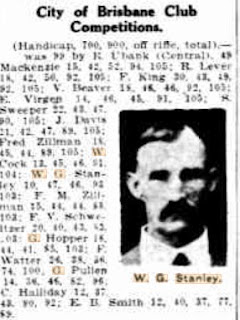
The skill that W G Stanley was well known and respected for in the town of Brisbane and Queensland was his marksmanship with the rifle. When he made the move to Beaudesert in 1913 the newspaper reported how the town's competitive shooting ability would definitely improve. Rifle shooting was a very popular and well documented sport in the early 20th century. William George or W. G. Stanley was definitely one of Brisbane's elite marksman. In October 1921 W. G. was selected to represent Queensland in the Commonwealth match to be held in Sydney.

W. G. Stanley on the left picture published August 16, 1933 in the Brisbane Telegraph.


The above is taken from the Truth, Sunday 19th February 1933

Courier-Mail (Brisbane, Qld. : 1933 - 1954), Tuesday 3 December 1946, page 12

STANLEY The Relatives & Friends of Mrs. R. A. Stanley, Mrs. M. Stephenson. Mr. & Mrs. A. E. Stanley, Mr. & Mrs. V. W. Farquharson, Mr. W. G. Stanley and Families are invited to attend the funcral of her beloved Husband, their father, Father-in-law, & Grandfather, Vllllam George Stanley, of Oxlade Drive, New Farm, to move from Alex. Gow's Funeral Chanel, Petrie Bight, This Tuesday afternoon, at 3 o'clock, for the Toowong Cemetery. ALEX. GOW. Funeral Director. 

STANLEY.— City of Brisbane Rifle Club. —The Members of the above Club are Invited to attend the Funeral of their late Club Member, William George Stanley, Vice-president, to move from the Funeral Chapel, as per family notice. 


May Dorothy Stanley

May Dorothy Stanley born at Shoncliffe, Montpellier Street, Clayfield on September 23 1906. The oldest of four children born to George William and Rosa Stanley.

Telegraph (Brisbane, Qld. : 1872 - 1947), Saturday 11 August 1934, page 15


BRISBANE GIRL WEDS IN ENGLAND 

Stephenson - Stanley Ceremony

THE wedding took place at St. Cuthbert's Church, Darlington (England, of Mr. Arthur Ernest Stephenson, of Ardlui, Yarm Road, Darlington, and Miss May Dorothy (Masie) Stanley, elder daughter of Mr. and Mrs. W. G. Stanley, of Brisbane. The bridegroom claims to be a direct descendant of George Stephenson, the railway pioneer. The bride was given away by Mr. J. F. Emerson, and was attended by Miss Evelyn Bantham. Mr. Cam Stephenson was best man and the Rev. R. F. Drury officiated.

The bride wore white satin beaute, cut on classical lines, with a train. She car-ried a double sheaf of lilies, to which was tied a silver horseshoe, given to her before she left Australia. Her head-dress was of old lace and orange blossom, with a long tulle veil. The bridesmaid's dress was of white georgette, sprigged with roses, with shoulder cape trimmed with white fur, and a striking bow of red satin to tone with her bouquet of red roses. She wore a large white hat with a red satin bow. The bridegroom's mother wore sprigged ninon, with hat to match. Dr. Kitson was the organist, and the reception was held at the bridegroom's home.

When the couple left for a honeymoon tour of Devonshire, the bride wore a blue-grey costume, with a large blue felt hat and shoes to tone. Those present included friends from Australia. Prior to leaving Brisbane Miss Stanley was the guest of honour at many pre-wedding tea parties.

Mr. and Mrs. Arthur Ernest Stephenson, leaving St. Cuthbert's Church, Darlington, England, after their marriage. Arthur Ernest Stephenson Born 28/11/1901 in Darlington, Durham. His father a forgeworker would have worked in one of the train building workshops that Darlington is historically known for. It could be assumed that he worked in the Stephenson train factory as there are documented records that he was descended from the inventor George Stephenson of the Stephenson Rocket and had his own train factory in Darlington.

Arthur Ernest Stephenson was a Royal Navy man and when WW2 started he was of course off to serve his country. Unfortunately his ship the "Banka" a minesweeper came to grief in the Malay Straights in December of 1941. He was the captain of the ship with three other British Navy officers and 40 Malay crew when it hit a Japanese mine on the 9th December. Only four Malay crew survived the disaster.

May or Maisie Stephenson lived at Casa Del Rio, Surfers Paradise after her husband's tragic death. She had two small children with her and one can only assume that life was very difficult. She died at her mother's home 123 Oxlade Drive. 

May Dorothy Stephenson Died 11/08/1948

Brisbane Telegraph (Qld. : 1948 - 1954), Thursday 12 August 1948, page 6

STEPHENSON.— The Relatives & Friends of Masters Allen & Richard Stephenson, of Surfers' Paradise, are invited to attend the Funeral of their beloved Mother, May Dorothy Stephenson, to move from Alex Gow's Funeral Chapel, Petrie Bight, To-morrow (Friday) Morning, at 11 o clock for the Toowong Cemetery. ALEX GOW, Funeral Director. 

STEPHENSON.— The Relatives & Friends of Mrs. R. A. Stanley, Mr. & Mrs. A  E. Stanley & Family, Mr. & Mrs. W. W Farquharson & Family, & Mr. W. G. Stanley are invited to attend the Funeral of her beloved Daughter, their Sister, Sister-in-law & Aunt, May Dorothy Stephenson, of Pacific Highway, Surfers' Para-dise, to move from Alex. Gow's Funeral Chapel, Petrie Bight, as per above notice. — ALEX. GOW, Funeral Director


William George (Bill) Stanley Jnr.

William George Stanley Jnr. was born at his home Doralma on the 25th September 1921 and was commonly known as Bill Stanley. He served in WW2 from 1939 to 1948 in the Royal Australian Navy. After leaving the service he married and moved to Ipswich where he ran a plastering business. 

As a small boy Bill Stanley would have been able to look out of the front window and see the Brisbane River. Water and sailing was obviously his passion as he went to become an international representative for his country in sailing. The 1926 Post Office Directory only has one house on River Road between Hazelwood and SArgent Streets and that is the Stanley's with a young Bill having his front yard and playground as the Brisbane River. His uncle Allen M Oxlade was an Australian Rugby Union representative and a household name in Queensland sporting circles in the first part of the 20th century. Young Bill must have inherited some Oxlade sporting genes as he was well known as a club rugby league player in the Ipswich competition. 

It is unknown why young Bill Stanley moved to Ipswich. As early as 1947 presumably after being discharged from the Navy he started travelling to Ipswich on a weekend to play Rugby League. After marrying Evelyn Lawn in March of 1948 he started his own plastering business in Ipswich and lived in the town till 1954 in East Street. By 1958 Bill and Evelyn had moved from Ipswich back to his childhood home of 123 Oxlade Drive. Bill was still registered on the electoral roll for 1943 as 123 Oxlade Drive so he only had approximately a decade away from living in his family home. His mother Rosa Alice Stanley continued to live at 123 Oxlade with her son and daughter in law until her death on the 14th. April 1981.

Queensland Times (Ipswich, Qld. : 1909 - 1954), Saturday 31 August 1946, page 7

Got His Nunber! Bill Stanley, Tivoli winger, is probably claiming four as his lucky number. On Saturday he missed his train from Brisbane, "thumbed" rides in four different vehicies and scored four tries. Incidentally, Bill is an expert rifle shot and a good sailor.

Queensland Times (Ipswich, Qld. : 1909 - 1954), Monday 16 August 1948, page 3

Tivoli played with white armbands as a mark of respect to the memory of teammate Bill Stanley's sister Mrs. M. 5tephenson, Surfers Paradise who passed away last Wednesday. 

Queensland Times (Ipswich, Qld. : 1909 - 1954), Saturday 27 November 1954, page 5

Sailor 

Local footballers will be keeping an eye on the sailing results tonight. Former Ipswich league forward, Bill Stanley, who gave up football to concentrate on sailing, will be engaged in the final of the 12ft. skiffs test race on the Brisbane River today and will sail with the 18-footers tomorrow. Bill's national title victory in the 18-footer Australia is well remembered in Ipswich, and his many friends will wish him well this afternoon.

Queensland Times (Ipswich, Qld. : 1909 - 1954), Thursday 23 June 1949, page 1


Bill and Evelyn Stanley were a couple who did not sit on the front verandah and admire the view. Bill obviously was a sporting man and one who loved the thrill of the race. He and Evelyn became involved in teh breeding and training of race horses. The following is taken from the Brisbane Racing Club Newsletter of March 7, 2018.

The first will be the opening of the Stanley Room, a dedicated display housing the collection of trophies, photographs and memorabilia associated with horses owned by Bill and Evelyn Stanley – two stalwarts of Queensland racing in the post-war era.

They raced no fewer than 99 horses including top liners Rajah Sahib, Cyron, Mr Cromwell, High Sail and among races they won were a Cox Plate, Stradbroke Handicap, Doncaster Handicap, Australian Cup and Queensland Derby. The Stanley Collection will illustrate the successes of the couple’s horses, from the early days when Mr Stanley owned and trained a small team from stables at Ipswich including one venture when he trucked three horses to Goondiwindi for a two-day meeting and won four races.
Mr Stanley had been an Australian champion sailor and a top rugby league footballer. He and Mrs Stanley established a successful plastics manufacturing business at New Farm and willingly helped out racing licensees down on their luck by giving them employment in their factory. Mr Stanley became a committeeman of the Queensland Turf Club. The Association with the support of the Brisbane Racing Club is putting the finishing touches on the Stanley Room. No date has been set for the opening.

The Stanley Room has been opened and one can visit to see the extensive collection.

https://www.queensland.com/us/en/things-to-do/attractions/p-5d19789fa6eb29c07e4edf32-thoroughbred-racing-museum-and-archives


My research has led me to believe that Bill with his plastering skills and knowledge turned his attention to plastic making. Whether this is Bill Stanley's business that has evolved into a company still operating today is unknown but the timeline and researched information match. The following is taken from teh current company's web site.

Stone Shields was first established in 1956 under the name of Auto Plastics, becoming Stone Shields in 1963. The company was run by the original owner until July of 2010 and all staff has worked in the company for over 12 years. Originally located in Arthur Street New Farm, Brisbane, we moved in 2003 to Newstead. Then, under new management we moved to Sandgate for three years before relocating to Brendale. We are the original manufacturers and wholesalers of weather shields in Australia, featuring a large range of patterns from 1948 through to current model vehicles.

When I first saw Doralma it stood out amongst the very extensive range of Queensland house architecture that stands along Oxlade Drive. It looked unique standing there as if to say "I have stood the test of time". What I did not know then that this house is more than a building providing a reminder of homes past but it is unique in that it is one single families home for more than a century. Doralma has seen family members born and die as well as tragedies and happiness over one families life time. Doralma an excellent example of the Queensland family home.

Saturday, November 6, 2021

Mountview Once Grand Now Sad

There are three prominent ridges that run to the north west of the centre of Brisbane town. In the early 1860s these ridges were where the more wealthy or prominent citizens of the town took up residence. Between these ridges were the low lying areas containing a vast range of dwellings usually small in size that catered for the workers. This area we now know as the roads of Wickham Terrace, Leichhardt Street and Gregory Terrace also early on was part of the Green Hills of Brisbane Town. There are still a small number of these substantial dwellings still standing that demonstrate the difference between the "top of the street" and "the bottom of the street". We now know the area as the suburb of Spring Hill and it is a very visual reminder of early Brisbane Town and early suburban growth. The areas of Kangaroo Point, South Brisbane and Spring Hill were the first suburban growth areas once commerce expanded within the early town and residential housing gave way to retail and commercial trade.
Mountview is listed on the Queensland Heritage Register and Brisbane City Council Register and a more complete historical picture of this house can be obtained from the following web links.


The following from the Queensland Heritage Register is a brief summary of how Mountview came about. The unobstructed views of the river, One Tree Hill and surrounding ranges would have easily provided a name for the house.  

"The earliest section of Mountview House, a two-storeyed stone residence, is believed to have been erected in the 1860s for Brisbane foreman carpenter Daniel McNaught. A two-storeyed brick wing designed by architect Andrea Stombucco was added in 1882, when the house was converted into a preparatory school for boys.

This part of Spring Hill was surveyed officially into suburban allotments in 1856, but was soon subdivided for closer residential settlement by speculative landowners. Along with Kangaroo Point and Petrie Terrace, Spring Hill was among the earliest of Brisbane's dormitory suburbs, attracting wealthier residents to the high land along the ridges, and the less affluent to the hollows in between: Hanly's Hollow [between Wickham Terrace and Leichhardt Street], Spring Hollow [between Leichhardt Street and Gregory Terrace], and York's Hollow [to the north of Gregory Terrace - an area occupied by a number of brick-makers in the 1850s and 1860s]."

The first reference of the Mountview link and the use of the house as a preparatory school with links to  the close by Brisbane Grammar School occurred in December 1879.


Mountview House became a boarding house and the Cameron Brothers from their office in the town Hall ran advertisements for the house. In 1890 an advertisement appeared describing the house as having 12 rooms, kitchen and servant quarters. In February of 1896 Mountview House advertised for boarders with furnished bedroom available and use of the kitchen. It appears from the advertisements that Mountview remained a boarding house through to the start of the first war. One of the key features mentioned is that it was on the "penny section tram". 

In July of 1916 the house was once again on the market and being promoted as one suitable for multi purpose use.


It does appear that the once magnificient home of Mountview or Mount View became a place of multi use. This situation is far removed from its original intention as a statement of position within the grand scheme of Brisbane's grand villas and homes of early Brisbane. Sadly in today's modern Brisbane it has now joined those reminders of a very different Brisbane. Heritage listed and sadly standing waiting for either its final decay with the ravishes of age or that wealthy saviour to rescue it back to its former glory.


Monday, October 11, 2021

Ormond - Home of Dr Fowles

 Ormond and Dr Fowles

At the turn of the 20th century Teneriffe Hill only had the estate of Teneriffe House. As the estate was sub divided and the houses of prominent citizens were built upon the hill access by public tansport was of concern. The residents of Chester amd James Streets had lobbyed the council for an extension of the tram from Brunswick Street and or Anne Street. 

A tram travelled down Brunswick Street to New Farm Park and a tram came down Fortitude Valley to Commercial Road and then to the Bulimba Ferry Terminal. The local Teneriffe residents wanted a tram extension along James Street to allow easier access to Teneriffe. A compromise it appears was the building of a set of stairs that ascended from Paterson Street to Teneriffe Drive. 

Brisbane Courier (Qld. : 1864 - 1933), Tuesday 9 January 1912, page 4

Notified motions by Alderman Best "That a one burner lamp be placed at a convenient point for lighting the footpath and stairs connecting Paterson street with Teneriffe Drive.

The access to Paterson Street was a short walk from the tram stop at Commercial Road and Kent Street.

The house at 40 Teneriffe Drive on the left at the top of the stairs that ascend from Paterson street is “Ormond”. Built in 1909 for Dr. E. W. H. Fowles. Dr. Fowles born at Oxley and the son of a school teacher became a well known identity in early 20th century Brisbane and Queensland. A barrister by profession the house is allegedly named after Ormond College at Melbourne University where he studied.

A biography of the life of a Teneriffe resident whose family provided a great service to the people of Queensland is provided in the link following.

https://adb.anu.edu.au/biography/fowles-edwin-wesley-6226

During WW2 the US forces occupied Ormond and Teneriffe House and the local stories abound. One being that a staff car would be ordered to ferry the officers the 50 meres between the two houses.


Telegraph (Brisbane, Qld. : 1872 - 1947), Saturday 29 December 1945, page 4
________________________________________
FOWLES. Relatives & Friends of Mrs. E. W. H. Fowles, of "Ormond," Teneriffe, are invited to attend the Funeral of her beloved Husband, Edwin Wesley Howard Fowles, M.A,, L.L.B., D. Litt., to leave Kingsholme Methodist Church, Teneriffe, on conclusion of Service commencing at 10 o'clock on Monday Morning, for the Mt. Thompson Crematorium. No flowers. JOHN H1SLOP & SONS. Funeral Directors. 


Why Homes of Brisbane

Why Homes of Brisbane

There is a saying that a home is every person's castle. Regardless of the size, style, cost, or placement a home is a place where memori...